

Chapter 4: Compact Design Is Only the Beginning
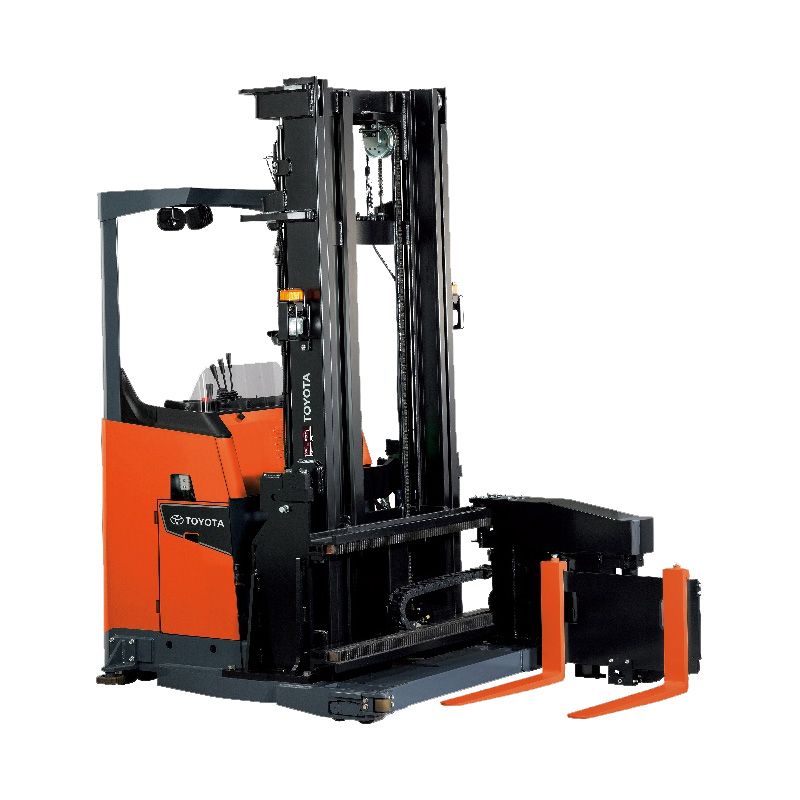
When people first see a Toyota very narrow aisle forklift, the most obvious impression is usually its compact structure. The vehicle looks slimmer, more agile, and significantly different from traditional forklifts.
However, the true value of VNA technology goes far beyond reducing vehicle width.
In fact, narrow aisle warehousing only works when multiple engineering systems operate together with extreme precision.
A forklift operating inside a 1.8-meter aisle cannot rely on brute force or oversized movements. Every steering adjustment, lifting action, and pallet alignment must remain highly controlled.
This is why advanced forklift Toyota systems focus heavily on electronic precision.
Modern Toyota warehouse forklifts integrate intelligent drive control systems that help operators maintain smoother directional adjustments even in tight environments. Instead of abrupt steering corrections, movements become fluid and predictable.
This has a direct impact on warehouse safety.
In high-density storage environments, a small positioning error can damage racks, products, or infrastructure. At higher lifting levels, instability becomes even more dangerous.
Toyota addresses this challenge through optimized hydraulic systems and enhanced mast stability.
When lifting heavy pallets to upper rack positions, the forklift remains balanced and controlled instead of swaying excessively. This allows operators to work more confidently at height while improving stacking accuracy.
Another important innovation is operator visibility.
Traditional forklifts often create blind spots due to bulky mast structures and large front bodies. In narrow aisle operations, limited visibility increases operational stress significantly.
Modern Toyota warehouse forklifts improve line-of-sight design so operators can monitor pallet positioning more accurately during lifting and retrieval tasks.
Reduced operator fatigue becomes another hidden advantage.
Many people assume narrow aisle operations are more difficult because the environment is tighter. In reality, intelligent steering assistance and smoother control systems often make operations easier compared to older forklift models.
Drivers spend less energy correcting steering positions, making wide turns, or repositioning pallets repeatedly.
Over long operational shifts, this contributes to better productivity and lower physical strain.
The forklift also becomes more digitally compatible.
Many modern warehouse management systems integrate directly with VNA equipment, enabling location guidance, task tracking, and semi-automated workflows.
This means the forklift is evolving from a simple transport tool into a data-connected warehouse asset.
The future warehouse will not depend solely on stronger machines.
It will depend on smarter machines capable of operating precisely inside increasingly optimized environments.
That is exactly where Toyota VNA forklift technology is leading the industry.
Chapter 5: High-Density Storage Without Sacrificing Efficiency
One of the biggest misconceptions about high-density warehousing is the belief that tighter storage automatically slows down operations.
Many warehouse operators initially worry that narrower aisles will create congestion, increase handling difficulty, and reduce picking efficiency.
In reality, the opposite is often true.
Poor warehouse efficiency is usually caused by disorganized layouts, inconsistent workflows, and excessive travel distance — not by storage density itself.
Traditional wide-aisle warehouses may appear spacious, but they often hide significant inefficiencies.
Operators travel longer routes.
Forklifts spend more time turning.
Inventory locations become scattered.
Dead space accumulates across the facility.
As warehouses scale larger, these inefficiencies multiply rapidly.
This is why many advanced logistics companies now prioritize workflow optimization instead of simply expanding operational space.
Modern very narrow aisle forklifts support this transformation by creating highly structured warehouse movement systems.
Instead of random traffic patterns, narrow aisle layouts naturally organize forklift movement into predictable routes.
This improves operational rhythm throughout the warehouse.
Picking paths become shorter.
Restocking becomes faster.
Inventory tracking becomes more accurate.
Traffic bottlenecks decrease significantly.
Another important advantage is vertical accessibility.
Traditional forklifts often struggle with efficient high-level retrieval, especially in dense rack environments. Operators may need multiple correction movements before aligning pallets correctly.
By contrast, very narrow aisle forklift trucks are designed specifically for precision high-rack operations.
This allows warehouses to fully utilize upper storage levels without sacrificing retrieval speed.
The improvement becomes especially noticeable during peak operational periods such as holiday sales, seasonal inventory surges, or promotional campaigns.
In these situations, warehouse congestion becomes one of the biggest operational risks.
A well-designed narrow aisle system helps maintain smoother material flow even under heavy workload pressure.
Another hidden efficiency gain comes from inventory organization.
High-density warehouses force businesses to adopt better inventory logic. Products are categorized more systematically, storage zones become clearer, and digital warehouse management systems become easier to implement.
This improves both operational speed and inventory accuracy.
For many businesses, the real breakthrough is psychological.
After transitioning to narrow aisle operations, warehouse teams often stop thinking in terms of “space shortage” and begin thinking in terms of “space optimization.”
That mindset shift changes how companies approach logistics growth long-term.
Instead of constantly chasing larger buildings, businesses learn how to maximize the profitability of existing facilities.
This is why many companies now see Toyota warehouse forklifts not merely as warehouse equipment, but as tools for operational transformation.
Chapter 6: The Hidden Financial Advantage of Toyota Warehouse Forklifts
When businesses evaluate warehouse equipment investments, they often focus only on the forklift purchase price.
But in modern logistics operations, the true financial impact of warehouse equipment extends far beyond initial acquisition cost.
In many cases, the largest warehouse expense is not equipment — it is space itself.
Warehouse rent continues increasing globally, especially in urban logistics hubs close to transportation networks and consumers.
For fast-growing businesses, storage expansion creates a dangerous financial cycle:
more inventory requires larger warehouses,larger warehouses increase operating costs,higher costs reduce profitability.
Many companies attempt to solve this problem by leasing additional facilities.
However, expansion creates multiple hidden expenses beyond rent alone.
Additional warehouses require:
more labor,
more lighting,
more climate control,
more security systems,
more inventory coordination,
and more transportation between facilities.
These costs accumulate quickly.
This is where Toyota warehouse forklift systems create a different financial model.
Instead of continuously increasing warehouse footprint, businesses can maximize the value of existing space through higher storage density.
This changes warehouse investment from “horizontal expansion” to “vertical optimization.”
The savings can be substantial.
Some companies postpone warehouse expansion projects for years simply by redesigning layouts around toyota warehouse forklifts and narrow aisle systems.
Others eliminate the need for external storage completely.
Another major financial advantage is operational durability.
Downtime is extremely expensive in modern logistics operations. A single forklift failure during peak periods can disrupt picking schedules, loading operations, and shipping timelines.
This is why equipment reliability matters as much as storage performance.
Many businesses choose Toyota forklifts because of their long-term operational stability and lower maintenance frequency.
Durable warehouse equipment reduces repair interruptions, improves uptime, and lowers total lifecycle ownership cost.
Energy efficiency also contributes to financial savings.
Electric narrow aisle forklifts often consume less operational energy compared to older fuel-powered warehouse systems. Combined with compact warehouse layouts, businesses can reduce overall facility operating expenses significantly.
Another hidden benefit is labor optimization.
Higher operational precision reduces product damage, rack collisions, and handling mistakes. Fewer operational errors translate directly into lower financial losses.
Over time, these small improvements compound into major profitability gains.
This is why advanced warehouse operators increasingly evaluate very narrow aisle forklift price differently.
The question is no longer:
“How much does the forklift cost?”
The smarter question becomes:
“How much money can optimized warehouse density save over the next ten years?”
That perspective completely changes the investment equation.
Chapter 7: Safety in Extremely Narrow Spaces
Many businesses hesitate before adopting narrow aisle warehousing for one simple reason: safety concerns.
At first glance, operating large loads inside extremely narrow spaces appears risky. Smaller aisles seem less forgiving, especially when forklifts are lifting heavy pallets several meters above ground level.
However, modern high-density warehousing is not built around risk — it is built around control.
In reality, many warehouse accidents occur not because aisles are narrow, but because operations lack structure and precision.
Traditional warehouse environments often create unpredictable forklift movement patterns. Operators travel across open spaces with varying speeds, inconsistent turning paths, and overlapping traffic routes.
This unpredictability increases collision risks significantly.
By contrast, narrow aisle systems create more disciplined operational flows.
Forklift paths become fixed.
Travel directions become clearer.
Rack spacing becomes standardized.
Operator behavior becomes more consistent.
This structured environment actually improves overall warehouse safety.
Modern forklift Toyota systems are designed specifically to support this type of controlled operation.
Advanced electronic steering systems help stabilize movement inside tight aisles. Operators can maintain smoother directional adjustments without sudden overcorrection.
Many Toyota warehouse forklifts also include intelligent speed management systems that automatically optimize travel performance based on lifting height and operational conditions.
As lifting height increases, stability becomes even more critical.
At upper rack levels, even small mast vibrations can affect pallet positioning accuracy. This is why Toyota VNA forklift equipment focuses heavily on mast rigidity and hydraulic balance optimization.
Stable lifting systems help operators place and retrieve pallets more safely while minimizing rack impact risks.
Another important safety feature is visibility enhancement.
Narrow aisle environments demand accurate depth judgment and precise pallet alignment. Modern Toyota warehouse forklifts are designed with optimized operator sightlines that reduce blind spots during stacking operations.
This improves confidence while reducing mental fatigue.
Many advanced warehouses also integrate digital safety technologies alongside very narrow aisle forklifts.
Examples include:
aisle guidance systems,
collision warning sensors,
warehouse traffic monitoring,
and semi-automated positioning assistance.
These technologies reduce human error while improving operational consistency.
Training efficiency also plays an important role.
Complex warehouse equipment can create safety risks when operators require long learning periods. Simpler and more intuitive control systems reduce onboarding difficulty and help new drivers achieve safe operation standards more quickly.
Another often overlooked factor is operator psychology.
In highly organized warehouse systems, operators experience less stress because workflows become predictable. Predictable workflows reduce panic reactions, rushed decisions, and unnecessary maneuvering errors.
In other words, the safest warehouse is not necessarily the warehouse with the most space.
It is the warehouse with the most controlled operational logic.
That is one reason why high-density warehousing continues expanding across modern logistics industries.