

Chapter 8: Why Toyota Forklift Dealers Matter More Than the Forklift Itself
Many companies spend months comparing forklift specifications, lifting capacities, battery performance, and pricing.
But after years of warehouse operation, many managers eventually realize a surprising truth:
The long-term value of a forklift often depends more on the dealer network than the machine itself.
Warehouse equipment is not a one-time purchase.
It is a long-term operational partnership.
Even the most advanced forklift can become a costly liability if maintenance support is slow, spare parts are unavailable, or technical service is unreliable.
This is why choosing the right Toyota forklift dealer is critically important.
Modern warehouses operate under intense time pressure.
A forklift breakdown during peak operation hours can delay shipments, interrupt inventory movement, and damage customer fulfillment performance.
Fast service response becomes essential.
Strong dealer networks provide businesses with:
faster maintenance support,
better spare parts availability,
operator training programs,
technical consultation,
and long-term fleet management assistance.
These factors directly affect warehouse uptime.
Another major advantage of experienced Toyota forklift dealers is warehouse planning expertise.
Many businesses underestimate how complex high-density warehouse design actually is.
Installing narrow aisle systems is not simply about buying a smaller forklift.
It requires careful planning involving:
rack spacing,
floor conditions,
battery charging infrastructure,
traffic flow design,
ceiling height optimization,
and operational workflow coordination.
Experienced dealers often help businesses design complete storage solutions rather than simply selling equipment.
This creates much better long-term operational results.
Operator training is another critical area.
Even advanced Toyota warehouse forklifts perform best when operators understand optimal driving techniques, battery management, and warehouse movement logic.
Professional dealer training improves both productivity and equipment lifespan.
Another hidden advantage is fleet scalability.
As businesses grow, warehouse needs evolve. Companies may gradually add more forklifts, redesign layouts, or integrate automation systems.
Strong dealer relationships make these transitions smoother because operational history and technical knowledge are already established.
Many businesses also prioritize resale value and lifecycle stability.
Reliable dealer networks help maintain equipment condition through proper servicing, which improves long-term asset value.
In many ways, the dealer becomes part of the warehouse ecosystem.
The forklift may move inventory,
but the dealer helps keep the entire operation running efficiently year after year.
This is why experienced logistics companies rarely choose warehouse equipment based only on initial price.
They evaluate the full support infrastructure behind the machine.
Chapter 9: The Future Warehouse Is Vertical, Intelligent, and Narrow
For decades, warehouses were designed around human movement.
Wide aisles allowed operators to maneuver freely, inventory systems relied heavily on manual experience, and storage layouts prioritized operational simplicity over density.
That era is ending.
The future warehouse is being redesigned around data efficiency, automation compatibility, and spatial optimization.
In this new logistics environment, vertical storage capacity becomes one of the most important competitive advantages.
Land prices continue rising.
Urban logistics demand continues growing.
Delivery expectations continue accelerating.
Under these pressures, inefficient warehouse layouts are becoming financially unsustainable.
This is why modern logistics facilities increasingly move toward high-density systems supported by very narrow aisle forklifts.
The goal is no longer simply storing inventory.
The goal is maximizing inventory movement efficiency per cubic meter of warehouse space.
Future warehouses will become more vertical than ever before.
Higher rack systems allow businesses to increase storage density dramatically without increasing land usage. But taller storage requires greater operational precision.
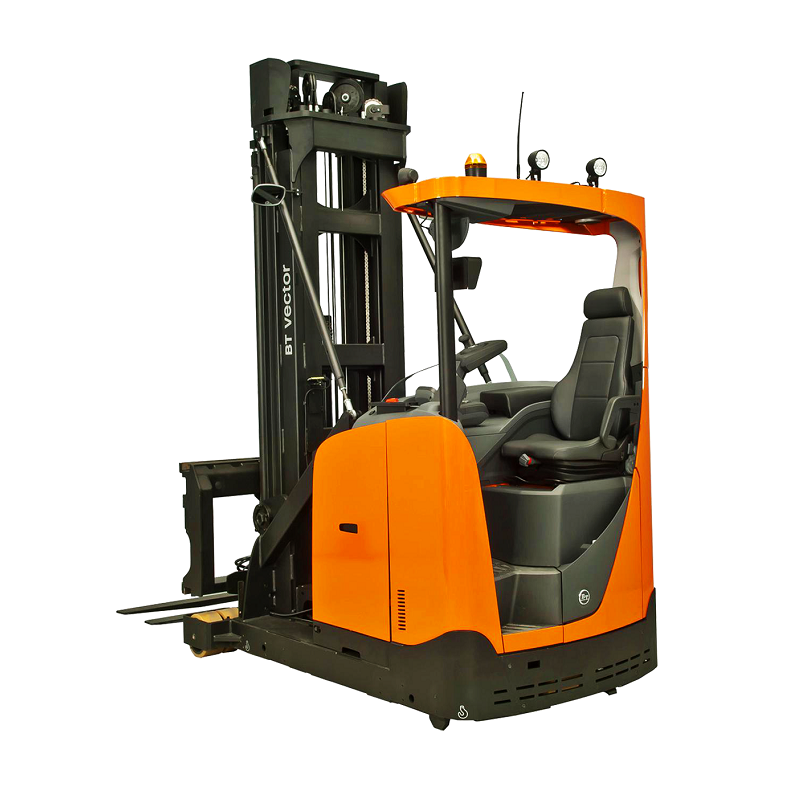
This is where Toyota very narrow aisle forklift technology becomes critical.
These systems are designed specifically for stable high-level operation inside tightly optimized warehouse environments.
At the same time, warehouses are becoming increasingly digital.
Inventory tracking systems,
AI warehouse management,
automated replenishment,
robotic picking assistance,
and predictive logistics software are transforming warehouse operations globally.
Narrow aisle layouts work exceptionally well with these technologies because operational routes become more structured and predictable.
Many future warehouse systems will combine human operators with semi-automated forklift guidance technologies.
Instead of replacing workers entirely, smart forklifts will assist operators by improving positioning precision, movement efficiency, and safety control.
Sustainability also plays an increasingly important role.
Compact warehouse layouts reduce energy consumption by minimizing building expansion requirements. Electric warehouse fleets reduce emissions while improving indoor operational conditions.
As environmental regulations become stricter globally, efficient warehouse infrastructure will become both an economic and environmental advantage.
Another major trend is micro-fulfillment logistics.
Companies increasingly need smaller urban warehouses located closer to customers. But urban warehouse space is extremely expensive and limited.
This makes high-density storage systems even more valuable.
Instead of building larger suburban distribution centers farther away from consumers, businesses can maximize compact urban warehouse capacity through intelligent narrow aisle design.
In many ways, the warehouse of the future will resemble a precision-engineered operating system rather than a traditional storage building.
Every movement will be optimized.
Every storage location will be calculated.
Every cubic meter will generate measurable value.
And at the center of this transformation, Toyota warehouse forklifts will continue playing a critical role in enabling smarter warehouse ecosystems.
Chapter 10: How to Choose the Right Very Narrow Aisle Forklift
Choosing the right very narrow aisle forklift is not simply about selecting the smallest forklift available.
A successful VNA warehouse system depends on matching equipment specifications with actual operational conditions.
Many businesses make the mistake of focusing only on forklift price or lifting height while ignoring the broader warehouse ecosystem.
In reality, selecting the correct Toyota VNA forklift requires analyzing several critical factors together.
The first factor is aisle width.
Different warehouse layouts require different maneuvering capabilities. Some facilities can support extremely narrow aisles around 1.8 meters, while others may require slightly wider configurations depending on rack structure and pallet size.
Before selecting equipment, businesses should carefully evaluate:
rack spacing,
turning clearance,
traffic flow,
and pallet dimensions.
The second factor is lifting height.
Higher storage density usually means taller rack systems. However, greater lifting heights require stronger mast stability and more precise control systems.
Not every forklift performs equally well at extreme heights.
Modern Toyota very narrow aisle forklift systems are specifically engineered for stable high-level operations, which becomes increasingly important in warehouses exceeding 10 meters of storage height.
The third factor is load type and pallet consistency.
Some warehouses handle uniform pallet sizes, while others manage irregular inventory shapes or mixed product categories.
Understanding average load weight, pallet dimensions, and product stability helps determine the most suitable forklift configuration.
Battery performance is another critical consideration.
Electric VNA forklifts often operate continuously in demanding warehouse environments. Businesses should evaluate:
battery endurance,
charging efficiency,
replacement cycles,
and energy management systems.
For high-intensity operations, battery strategy directly affects warehouse productivity.
Floor conditions also matter significantly.
Narrow aisle systems require stable, level flooring for optimal safety and performance. Uneven surfaces may affect lifting stability and steering precision.
Many professional Toyota forklift dealer teams help customers inspect floor conditions before installation.
Another important consideration is warehouse scalability.
Businesses should avoid selecting equipment only for current inventory needs. Future warehouse growth, automation integration, and rack expansion plans should all influence forklift selection decisions.
This forward-thinking approach helps avoid expensive system redesigns later.
Technology compatibility is becoming increasingly important as well.
Modern warehouses often integrate:
warehouse management systems (WMS),
barcode tracking,
fleet monitoring,
and semi-automated logistics software.
Choosing forklifts capable of supporting future digital upgrades creates better long-term operational flexibility.
Finally, businesses should evaluate total ownership value instead of focusing only on very narrow aisle forklift price.
The cheapest forklift may ultimately create higher maintenance costs, shorter lifespan, and lower operational efficiency.
The best investment is usually the forklift system that improves:
space utilization,
workflow stability,
operator productivity,
and long-term operational reliability simultaneously.
Because in modern warehousing, equipment should not only move products.
It should improve the entire logistics system.
Contact Us