

Introduction: Why Warehouses Are Running Out of Space Faster Than Ever
Warehouses around the world are facing a strange contradiction: buildings are getting larger, yet storage space still feels insufficient. The rise of e-commerce, fast-delivery expectations, and diversified inventory structures has dramatically increased pallet density requirements. Businesses are storing more SKUs than ever before, but traditional warehouse layouts remain trapped in outdated operational logic.
For years, companies believed warehouse expansion was the only solution. When capacity became tight, they rented another facility, built a larger warehouse, or reduced inventory turnover pressure through costly outsourcing. However, rising industrial land prices and continuously increasing warehouse rents are making this strategy unsustainable.
The real issue is not the size of the warehouse — it is the inefficient use of internal space.
In many conventional facilities, aisle width consumes an enormous percentage of the building footprint. Traditional counterbalance forklifts often require aisles wider than 3.5 meters simply to turn safely. That means warehouses are sacrificing valuable storage positions just to create driving paths.
Modern logistics operators are beginning to rethink warehouse design from a completely different perspective. Instead of asking, “How can we build bigger warehouses?” they ask, “How can we make existing warehouses store twice as much?”
This shift has accelerated the demand for Toyota warehouse forklifts, especially specialized Toyota very narrow aisle forklift systems designed for high-density storage environments.
Unlike standard forklifts, very narrow aisle forklifts are engineered specifically for vertical warehouse optimization. Their compact structure, precise steering systems, and high-level lifting stability allow businesses to reduce aisle widths dramatically while increasing rack density.
The result is transformational.
Warehouses that once stored 5,000 pallets may suddenly support 8,000 or even 10,000 pallet positions without expanding the building itself. Companies save on rent, avoid costly construction projects, and improve operational efficiency simultaneously.
Another overlooked advantage is workflow optimization. Narrow aisle layouts force warehouses to become more organized. Inventory paths become more structured, pallet movement becomes more predictable, and traffic congestion decreases. In many cases, efficiency improves alongside storage density.
Today, industries ranging from e-commerce fulfillment centers to cold-chain logistics and manufacturing warehouses are rapidly adopting Toyota forklifts for this exact reason.
Interestingly, the philosophy behind high-density warehousing is similar to precision manufacturing. Just as a modern polishing machine
improves efficiency by optimizing surface processing instead of wasting material, narrow aisle warehouse systems optimize spatial efficiency instead of wasting industrial real estate.
As global supply chains become increasingly competitive, warehouse space is no longer just a storage issue — it is a strategic business asset. Companies that maximize storage density without compromising efficiency will gain a major operational advantage in the years ahead.
Chapter 1: The Real Enemy Is Not Warehouse Size — It's Inefficient Aisle Design
Most warehouse managers believe storage pressure comes from insufficient building area. But after analyzing modern logistics facilities, a surprising reality appears: the biggest waste inside many warehouses is not empty shelves — it is oversized forklift aisles.
Traditional forklifts were designed decades ago for low-density operations. At that time, land costs were lower, inventory turnover was slower, and warehouse layouts prioritized maneuverability over storage density. Today’s logistics industry operates under completely different conditions.
E-commerce warehouses must handle thousands of SKU categories simultaneously. Manufacturing warehouses need faster raw material turnover. Cold storage facilities face extremely high operating costs per square meter. Under these pressures, every meter of warehouse space becomes valuable.
Yet many facilities still dedicate massive floor areas to forklift turning movements.
A conventional forklift often requires more than 3.5 meters of aisle width to operate safely. Once multiple aisles are added across an entire warehouse, the amount of space lost becomes enormous. In many cases, aisle space occupies nearly as much room as the inventory itself.
This is where Toyota warehouse forklift systems fundamentally change warehouse economics.
Instead of designing warehouses around forklift limitations, Toyota warehouse forklifts are engineered to adapt to high-density layouts. By dramatically reducing turning radius requirements, warehouses can compress aisle widths to approximately 1.8–2.5 meters.
That difference may seem small on paper, but operationally it changes everything.
Narrower aisles allow businesses to install additional rack rows throughout the warehouse. More rack rows mean more pallet positions. More pallet positions mean higher storage density without increasing building size.
However, the transformation is not only about “adding shelves.” It also changes warehouse psychology.
Traditional wide-aisle warehouses often create chaotic movement patterns. Operators drive longer distances, inventory becomes fragmented, and traffic congestion increases during peak hours.
By contrast, narrow aisle warehouse systems force operations to become more systematic. Inventory lanes become more organized, forklift paths become predictable, and storage locations become easier to manage digitally.
This is why many global distribution centers now view aisle optimization as a strategic advantage rather than a simple equipment upgrade.
Another important factor is energy efficiency.
Larger warehouses require more lighting, air conditioning, and operational energy. When businesses maximize vertical storage capacity instead of expanding horizontally, they reduce overall facility operating costs significantly.
In some advanced warehouse projects, companies have discovered that optimizing aisle width delivers better ROI than building entirely new facilities.
This is the hidden logic behind modern high-density warehousing:
the future of warehousing is not bigger buildings — it is smarter space utilization.
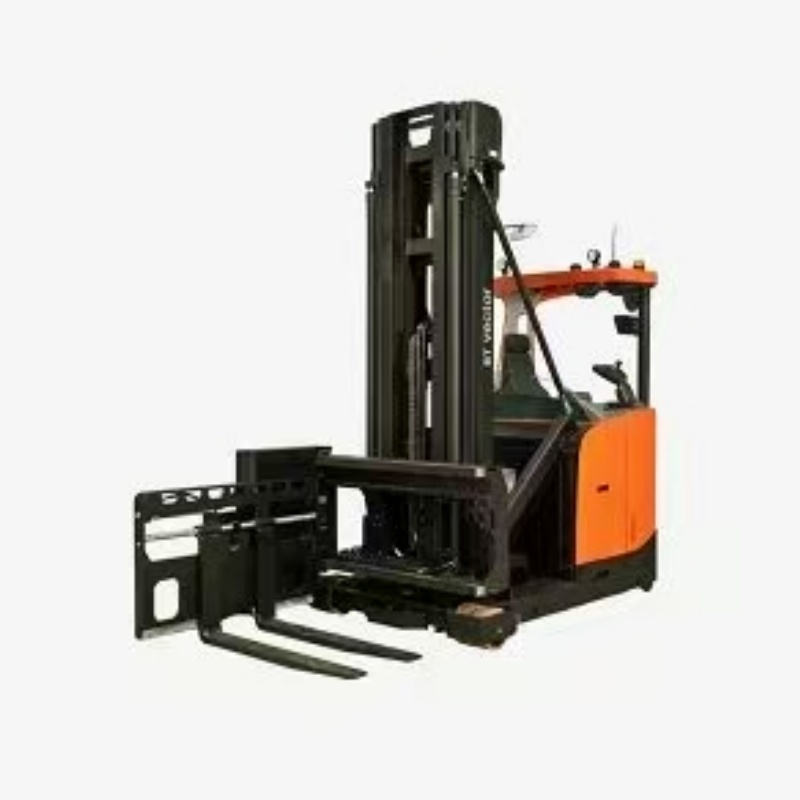
Chapter 2: How Toyota Very Narrow Aisle Forklifts Change Warehouse Mathematics
Warehouse storage has traditionally been treated like a two-dimensional problem: more inventory requires more floor space. But Toyota VNA forklift technology changes warehousing into a vertical optimization strategy.
Modern warehouses no longer compete only on location or size. They compete on how efficiently they convert cubic space into profitable inventory capacity.
This distinction is critical.
Most warehouses only utilize a fraction of their vertical potential. Even facilities with high ceilings often fail to maximize storage because conventional forklifts cannot safely operate at extreme lifting heights inside narrow environments.
That limitation disappears with Toyota very narrow aisle forklift systems.
These forklifts are specifically designed for tall racking operations and ultra-narrow aisle movement. Instead of spreading inventory horizontally across wider floor areas, businesses can stack inventory vertically while maintaining operational efficiency.
The economic impact is dramatic.
A warehouse that previously required external storage facilities may suddenly consolidate all inventory into a single building. Businesses reduce transportation costs between warehouses, simplify inventory management, and improve order fulfillment speed.
More importantly, high-density storage changes inventory visibility.
In traditional warehouse environments, excess spacing often creates disorganized storage behavior. Operators place pallets wherever space appears available, leading to fragmented inventory distribution.
With structured narrow aisle systems, storage becomes more intentional. Every pallet location is optimized. Every aisle movement is calculated. Every cubic meter contributes to operational productivity.
This approach aligns perfectly with modern warehouse automation trends.
Many companies integrating robotics, barcode tracking, and AI inventory systems prefer narrow aisle layouts because the environment becomes more predictable and digitally manageable.
Another overlooked advantage is labor efficiency.
When warehouse layouts become compact and systematic, operators travel shorter distances during picking and replenishment tasks. Over thousands of daily movements, these small savings create major productivity gains.
Some companies report that after implementing very narrow aisle forklift trucks, their warehouses not only increased storage density but also reduced operational fatigue among workers.
The transformation becomes even more valuable in urban logistics centers where industrial real estate prices continue rising aggressively.
Instead of renting larger facilities farther away from customers, businesses can increase storage density inside existing locations and maintain faster delivery performance.
This is why forklift Toyota solutions are increasingly viewed as infrastructure investments rather than simple warehouse equipment.
The forklift is no longer just a machine.
It becomes a strategic tool for redefining warehouse profitability.
Chapter 3: Why Traditional Forklifts Fail in Modern E-Commerce Warehouses
The warehouse industry has changed faster in the last ten years than in the previous fifty.
Traditional forklift systems were designed for bulk storage, slower inventory turnover, and relatively predictable logistics patterns. But modern e-commerce warehouses operate under entirely different conditions.
Today's warehouses face constant pressure from same-day delivery expectations, fragmented SKU structures, rapid order picking, and seasonal traffic surges.
Under these conditions, traditional forklifts begin exposing their weaknesses.
Wide turning requirements reduce rack density.
Long maneuvering paths waste time.
Large vehicle bodies increase collision risks.
High-level stacking becomes unstable in narrow spaces.
As order volumes increase, these inefficiencies multiply rapidly.
Modern warehouses no longer succeed simply by storing inventory. They succeed by moving inventory quickly and accurately.
This is where very narrow aisle forklifts become essential.
Unlike conventional forklifts, VNA systems are engineered specifically for environments where storage density and operational speed must coexist.
Their compact body structures allow operators to navigate extremely narrow aisles while maintaining lifting stability at higher rack levels.
More importantly, the forklift becomes part of a broader warehouse optimization strategy.
Instead of operators improvising movements inside wide open spaces, narrow aisle systems encourage predictable operational flows.
This predictability is extremely valuable for e-commerce operations.
Fast-moving products can be organized closer to dispatch zones.
Picking routes become shorter.
Traffic congestion decreases.
Inventory accuracy improves.
The result is not only more storage capacity but also faster order fulfillment performance.
Another major issue in modern warehouses is labor training.
Traditional forklifts often require significant operator experience, especially in high-rack environments. Mistakes can easily damage racks, products, or warehouse infrastructure.
However, many Toyota forklifts integrate intelligent control systems that simplify operation dramatically.
Electronic steering assistance, smoother hydraulic control, and improved visibility allow new operators to adapt more quickly while reducing operational risk.
This matters because labor shortages continue affecting global logistics industries.
Warehouses increasingly need equipment that improves productivity while reducing operator dependency.
Furthermore, modern e-commerce inventory changes constantly. Seasonal products, promotional campaigns, and rapidly shifting consumer demand require warehouses to adapt layouts frequently.
Flexible narrow aisle systems make these transitions easier because storage density can increase without expanding the facility footprint.
In other words, Toyota warehouse forklifts are not simply replacing older forklifts.
They are helping warehouses evolve into faster, smarter, and more scalable logistics systems.
Contact Us