

1. Warehouses Are No Longer Competing on Size — They Compete on Speed
Ten years ago, warehouse competitiveness was mainly determined by space. Companies believed that larger buildings meant greater storage capacity and stronger logistics capability. Today, that logic has completely changed.
Modern logistics competition is now based on movement efficiency. The faster goods can move from receiving, storage, picking, and shipping, the stronger the warehouse becomes. In many industries, the real bottleneck is no longer inventory volume — it is operational flow.
This shift is why more businesses are upgrading to Toyota warehouse forklifts. These machines are designed not only to lift cargo, but to optimize the rhythm of warehouse movement itself.
Traditional forklifts often create hidden inefficiencies. Wide turning requirements force warehouses to reserve excessive aisle space. Slower positioning creates congestion during peak operation hours. In high-density storage environments, even a few seconds lost per operation can eventually become hours of wasted labor every week.
A modern Toyota warehouse forklift changes that operating model completely. Instead of adapting warehouse layouts around equipment limitations, companies can now redesign warehouse flow around compact, precision-controlled forklift systems.
This is why many fast-growing distribution centers are shifting toward Toyota warehouse solutions. The goal is no longer simply “moving goods.” The goal is creating a warehouse that behaves like a synchronized logistics engine.
2. The Biggest Waste in Warehouses Is Often Invisible
Most warehouse managers focus on visible costs: labor, rent, electricity, and equipment investment. However, the largest productivity losses usually come from invisible operational waste.
For example, many forklifts travel unnecessary distances every day simply because aisle layouts are inefficient. Operators spend extra time correcting positioning during pallet stacking. In high-rack environments, unstable lifting forces workers to slow down operations for safety reasons.
These problems rarely appear in financial reports directly, but they silently reduce warehouse efficiency every single day.
This is where Toyota warehouse forklifts stand out. Toyota focuses heavily on reducing “micro-inefficiencies” inside warehouse operations.
The compact body structure allows operators to move through narrow aisles more naturally. Precise steering systems reduce repeated correction movements. Smooth lifting performance improves stacking confidence at high elevation levels.
What makes the difference even larger is consistency. A warehouse does not become efficient because one operation is fast. It becomes efficient when thousands of operations can be repeated smoothly with minimal interruption.
That is exactly the operational philosophy behind modern Toyota warehouse equipment.
3. Why Narrow Aisle Warehouses Are Becoming the New Standard
Warehouse expansion used to mean constructing larger buildings. Today, many companies are taking a completely different approach: increasing storage density inside existing facilities.
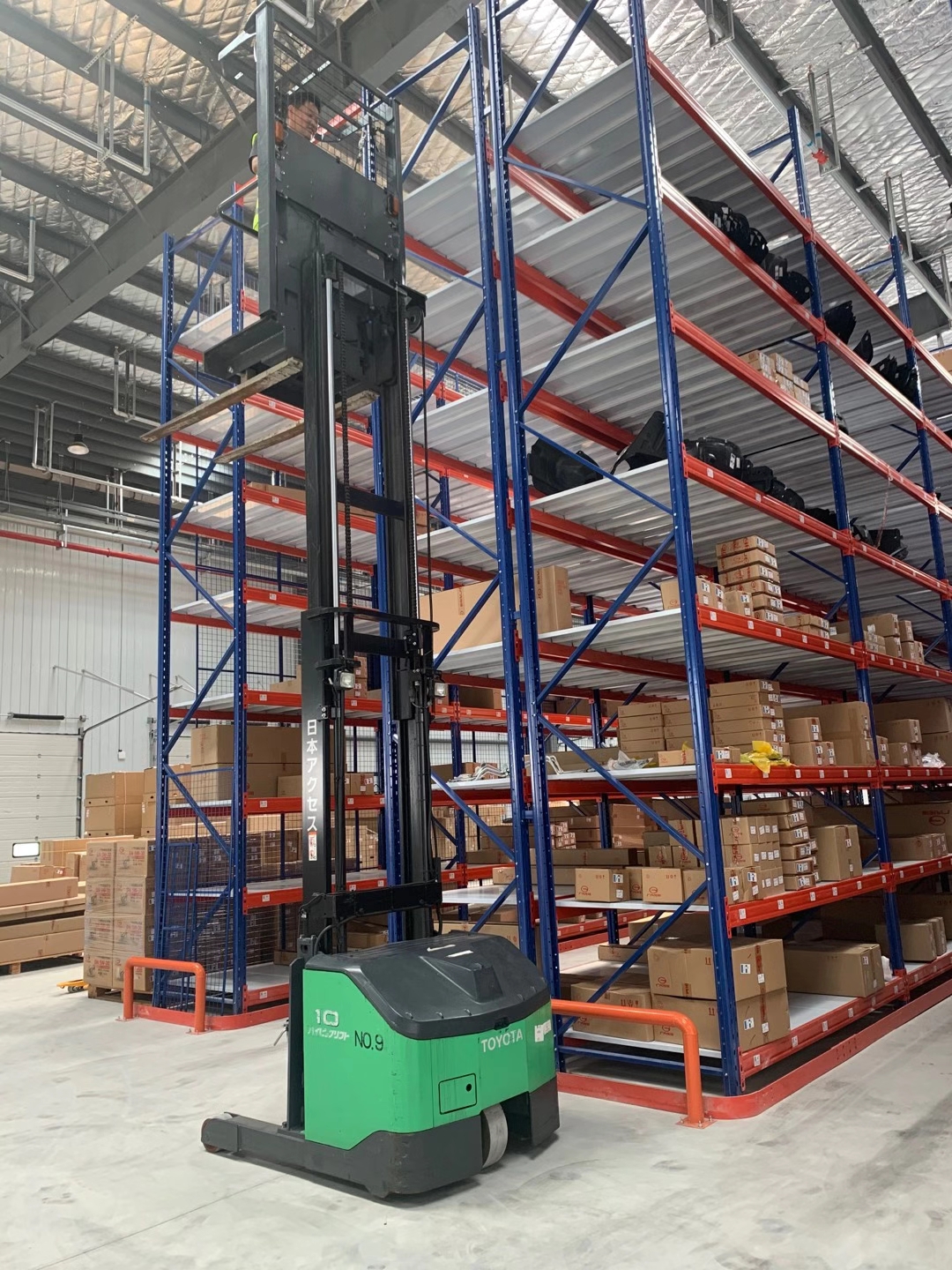
This strategy explains the growing demand for Toyota warehouse forklift solutions designed for narrow aisle environments.
Traditional forklifts require large turning radiuses, which forces warehouses to sacrifice valuable storage space. Toyota’s warehouse models solve this issue through compact engineering and highly responsive maneuverability.
By narrowing aisle width, businesses can install additional rack rows without increasing warehouse size. In some operations, this creates dramatic storage gains while also shortening travel distance between inventory locations.
The impact goes beyond space savings. Narrow aisle operations also improve workflow concentration. Operators spend less time navigating open areas and more time completing productive movements.
As warehouse rental costs continue rising globally, space efficiency is becoming just as important as labor efficiency.
For many logistics companies, upgrading to narrow aisle Toyota systems is not simply a forklift replacement — it is a warehouse restructuring strategy.
4. Stability Is the Real Secret Behind Faster Warehouse Operations
Many people assume warehouse speed depends entirely on driving speed. In reality, operational stability is often far more important.
An unstable forklift slows down warehouse rhythm. Operators hesitate during high lifting. Pallets require repeated adjustments. Rack positioning becomes inconsistent. Over time, these small delays significantly reduce throughput.
This is one reason why Toyota forklifts are widely trusted in high-density logistics environments.
Toyota's warehouse systems prioritize smooth acceleration, balanced lifting, and stable movement control. Operators can complete storage and retrieval tasks with greater confidence and fewer interruptions.
The result is not aggressive speed, but controlled speed — which is far more valuable in continuous warehouse operations.
Stable handling also reduces product damage. Fewer collisions mean lower inventory loss, reduced maintenance costs, and less workflow disruption.
Interestingly, this same concept exists in precision manufacturing equipment. Even industrial systems such as a polishing machine depend heavily on stable, repeatable motion control to maintain production quality and operational efficiency.
5. Why Toyota Warehouse Forklifts Reduce Labor Pressure
Labor shortages are becoming a major challenge across the logistics industry. Many warehouses struggle to recruit experienced forklift operators, especially during seasonal demand peaks.
One major advantage of Toyota warehouse forklifts is their operator-friendly design philosophy.
The control systems are intuitive, steering response is smooth, and lifting operations feel predictable even for newer workers. This significantly reduces training difficulty and shortens adaptation time.
Instead of relying entirely on highly experienced operators, warehouses can create more standardized workflows that are easier to scale.
Toyota also focuses heavily on reducing operator fatigue. Comfortable driving posture, smoother movement transitions, and lower vibration levels all contribute to longer productive working periods.
In modern logistics, reducing physical and mental workload is becoming just as important as increasing machine performance.
A warehouse that is easier to operate is usually a warehouse that operates more efficiently.
6. The Future Warehouse Is Built Around Intelligent Movement
The future of warehousing is not just automation — it is intelligent movement coordination.
Modern logistics systems are increasingly combining warehouse management software, barcode systems, automated sorting lines, and smart forklift operations into one synchronized ecosystem.
This is where forklift Toyota systems become especially valuable.
Toyota warehouse equipment is designed to integrate smoothly into larger operational structures. Instead of acting as isolated machines, forklifts become part of a continuous logistics network.
As warehouses become more data-driven, movement precision becomes increasingly important. Every unnecessary turn, stop, or reposition creates measurable operational inefficiency.
The future warehouse will not simply store products faster. It will move products smarter.
And that transformation is already happening today.
7. How to Choose the Right Toyota Forklift Dealer
Choosing the right Toyota forklift dealer is often just as important as choosing the forklift itself.
A professional dealer does more than sell equipment. They analyze warehouse layout, traffic flow, rack structure, and operational frequency before recommending suitable models.
Good dealers also provide long-term maintenance support, operator training, and upgrade planning. This helps warehouses maintain stable performance over many years.
The best forklift investment is not necessarily the cheapest machine — it is the system that creates the highest long-term operational efficiency.
Contact Us
FAQ
① What industries commonly use Toyota warehouse forklifts?
E-commerce, manufacturing, cold chain logistics, retail distribution, and high-density storage centers.
② Can Toyota warehouse forklifts work in narrow aisles?
Yes. Many models are specifically designed for compact warehouse layouts and high-rack environments.
③ Why are Toyota forklifts considered efficient?
Because they focus on movement precision, operational stability, and warehouse flow optimization rather than only lifting power.
④ Do Toyota warehouse forklifts help reduce labor costs?
Yes. Easier operation, lower training difficulty, and higher workflow efficiency can significantly reduce labor pressure.