

1. Introduction: Why High-Temperature Environments Are the Real Stress Test for Toyota Diesel Forklifts
High-temperature environments are not just uncomfortable working conditions—they are one of the most aggressive stress tests for industrial machinery. For a Toyota diesel forklift, heat directly impacts engine stability, hydraulic response, fuel efficiency, and overall safety performance.
Unlike normal operating conditions, high heat environments create a compounding effect. Engine combustion temperature rises, cooling efficiency drops, and hydraulic oil viscosity becomes unstable. This means that a Toyota diesel forklift working under heavy load in hot weather is not only consuming more energy but also operating closer to its mechanical limits.
The reason diesel forklift Toyota models are widely used in ports, factories, and outdoor logistics yards is because they are engineered for durability and continuous operation. However, even the most robust toyota forklift diesel system is not immune to thermal overload if operational habits and maintenance strategies are ignored.
In real-world applications, overheating is rarely caused by a single failure. It is usually the result of accumulated thermal stress: blocked airflow, extended idling under load, improper cooling maintenance, or inefficient shift scheduling.
This guide is designed to shift your understanding from simple forklift operation to a thermal risk management system, helping operators and fleet managers maximize performance, extend equipment lifespan, and reduce downtime.
Keywords integrated: toyota diesel forklift, diesel forklift toyota, toyota forklift diesel
2. Understanding Heat Impact on a Toyota Diesel Forklift System
A high-temperature working environment does not affect a Toyota diesel forklift in a single way—it impacts the entire machine as an interconnected thermal system.
The engine is the primary heat source, but it is not the only one. A Toyota forklift diesel system also includes hydraulic circuits, transmission components, and cooling airflow channels. When ambient temperature rises, each subsystem begins to lose efficiency at the same time.
Engine heat increases combustion stress, while cooling efficiency decreases due to hotter intake air. At the same time, hydraulic oil becomes thinner and less stable, reducing lifting precision. This is why a diesel forklift Toyota operating in extreme heat often shows slower response, reduced lifting power, and higher fuel consumption.
What makes the issue more complex is heat accumulation. Instead of dissipating, thermal energy builds up during continuous operation, especially in heavy-load cycles. If airflow is restricted or idle time is excessive, the system gradually enters a thermal overload state.
Understanding this system-wide heat behavior is the first step toward preventing breakdowns and improving long-term reliability.
3. Pre-Operation Thermal Risk Preparation Strategy (Not Just Inspection)
Before operating a Toyota diesel forklift, preparation should go beyond basic inspection. It should be treated as a thermal risk forecasting process.
For a Toyota forklift diesel system, cooling readiness is the first defense layer. This means checking coolant level, radiator cleanliness, and airflow paths before the machine even starts working.
However, a more advanced approach involves predicting heat behavior. For example, if the previous shift experienced heavy load cycles, residual heat may still exist in the engine and hydraulic system.
Operators should also evaluate fluid conditions—not just levels. Engine oil degradation and coolant aging reduce heat transfer efficiency, especially in summer.
Instead of reacting to overheating, the goal is to prevent the system from entering high-risk thermal zones in the first place.
4. Smart Operation Strategy in High Temperature Worksites
Operating a Toyota diesel forklift in high temperatures requires adaptive driving logic rather than fixed habits.
A Toyota forklift diesel should never be pushed continuously at full load in hot environments. Instead, load should be distributed in cycles to allow periodic thermal recovery.
Speed control is another key factor. Sudden acceleration or braking increases engine load spikes, which directly translates into heat spikes. Smooth operation helps maintain thermal balance.
Work scheduling is equally important. Avoiding peak noon temperatures can significantly reduce system stress. Many operators rotate shifts to keep diesel forklift Toyota units from overheating under continuous exposure.
The goal is not just productivity—it is controlled thermal stability during every movement.
5. Engine Cooling & Heat Dissipation System Protection
Cooling efficiency determines the survival of a Toyota diesel forklift in extreme heat.
The radiator system must remain unobstructed. Even small dust buildup can significantly reduce airflow efficiency. For a Toyota forklift diesel, this directly increases engine temperature during continuous load cycles.
Fan belt performance is another critical factor. A slipping belt reduces airflow speed, weakening the entire cooling system.
After heavy operation, idling for a short period allows heat to dissipate gradually. Abrupt shutdown traps heat inside the engine, increasing long-term wear.
Proper cooling management is not maintenance—it is real-time protection.
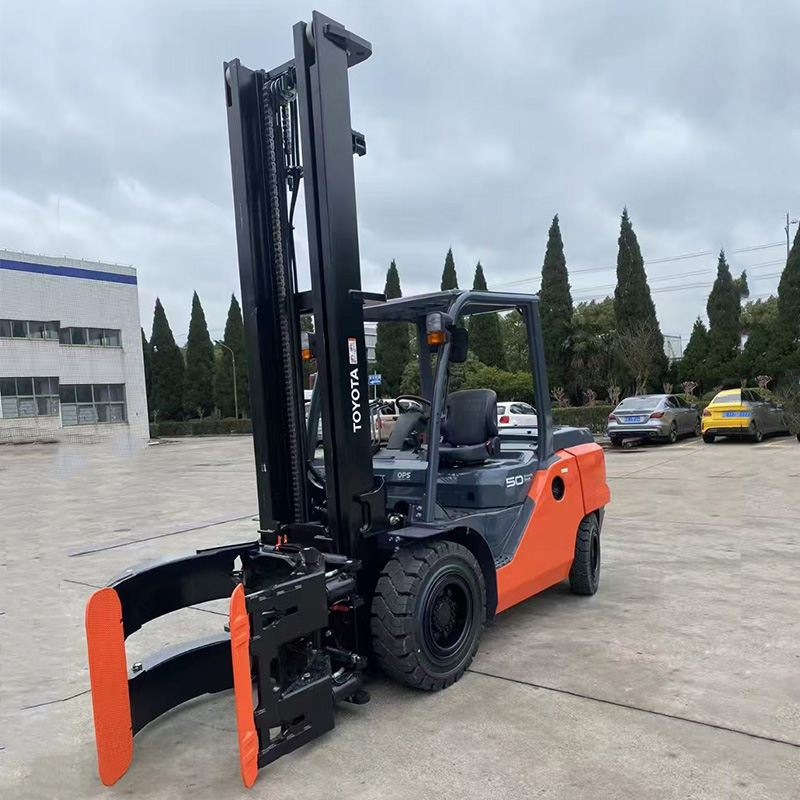
6. Hydraulic System Heat Behavior and Control
The hydraulic system of a Toyota forklift diesel unit is often more sensitive to heat than the engine itself.
As temperature rises, hydraulic oil viscosity drops, reducing lifting precision and increasing internal leakage. This results in slower response and weaker lifting force in a Toyota diesel forklift truck.
If hydraulic operation feels “soft” or delayed, it is often a sign of thermal overload. Continuing operation under these conditions accelerates system damage.
Selecting heat-resistant hydraulic oil designed for summer operation can significantly stabilize performance.
Hydraulic temperature control is essential for maintaining safe lifting operations.
7. Maintenance Strategy for Extreme Summer Operations
For a Toyota diesel forklift, summer maintenance must be more frequent and proactive.
Filters such as air filters, oil filters, and fuel filters degrade faster under high heat and dust conditions. Replacing them earlier prevents airflow restriction and combustion inefficiency.
Cooling system cleaning should be scheduled regularly. Radiators and cooling grids accumulate dust quickly in outdoor environments.
Battery terminals should also be checked, as heat increases oxidation risk and starting difficulty.
Preventive maintenance is the foundation of stable summer operation.
8. Operational Mistakes That Accelerate Overheating
Many overheating issues in a Toyota diesel forklift are caused not by failure, but by repeated operational mistakes.
The most common issue is continuous overload operation without cooling intervals. This prevents heat dissipation and accelerates system stress.
Ignoring early warning signs such as reduced power or slower response leads to severe thermal damage.
Improper shutdown behavior is another major mistake. Turning off the engine immediately after heavy load traps heat inside critical components.
Operational discipline is as important as mechanical reliability.
9. Advanced Heat Management Best Practices
Advanced operators of Toyota diesel forklifts use heat as a performance indicator, not just a risk factor.
Instead of pushing equipment to limits, they manage workload based on thermal response. If heat rises too quickly, they reduce load density rather than stopping completely.
Fleet rotation is also an advanced strategy. Multiple units are alternated to prevent any single forklift Toyota diesel from entering continuous thermal stress.
This system-based approach significantly improves uptime and reduces breakdown risk.
10. Buying Guide: Choosing the Right Toyota Diesel Forklift for Hot Environments
When selecting a Toyota diesel forklift, cooling design should be a top priority—not just price.
A well-designed cooling system ensures long-term stability under heat stress. Buyers should evaluate radiator size, airflow structure, and engine compartment layout.
Price comparison is important, but focusing only on Toyota diesel forklift price can lead to underestimating long-term maintenance costs.
Choosing a durable model ensures better ROI in high-temperature regions.
11. Market Overview: Toyota Diesel Forklift Availability and Cost Factors
The market for Toyota diesel forklifts varies depending on usage condition, age, and region demand.
Hot-climate regions often increase demand for durable units, affecting availability and pricing. Both new and used markets are active.
Listings such as Toyota diesel forklift for sale or Toyota diesel forklifts for sale often reflect condition-based pricing rather than fixed standards.
Understanding market variability helps buyers make informed decisions.
12. Conclusion: Turning Heat Stress into Operational Advantage
High-temperature environments are often seen as a challenge, but for a well-managed Toyota diesel forklift fleet, they can become an operational advantage.
By understanding thermal behavior, optimizing operation strategies, and maintaining proactive cooling systems, companies can significantly improve uptime and efficiency.
The key is not avoiding heat—but managing it intelligently.