

1. Why “Used Toyota Forklift” Is No Longer a Compromise
For many years, “used forklift” was associated with risk, downtime, and uncertainty. That perception no longer holds true—especially when it comes to Used Toyota Forklift solutions.
Toyota designs forklifts with long-duty industrial cycles in mind. Frames, masts, hydraulic systems, and powertrains are engineered to operate reliably far beyond the initial ownership period. As a result, many Used Toyota Forklifts still deliver stable performance even after years of service.
What buyers are really getting today is not a second-hand machine, but a fully proven productivity tool—one that has already passed the failure-prone early stage of its lifecycle.
2. The Hidden Logic Behind Buying Used Toyota Forklifts
The real reason companies choose Used Toyota Forklifts has little to do with saving money upfront. It is about predictability.
Used equipment comes with history. You can evaluate how it was used, what failed, what was repaired, and what continues to perform well. In contrast, new forklifts carry unknowns—new components, new electronics, and untested operating conditions.
Experienced buyers understand that proven reliability often outweighs theoretical perfection. A used Toyota forklift that has already worked thousands of hours without structural issues is often a safer operational choice.
3. Used Toyota Forklift Price: What You're Really Paying For
When discussing used Toyota forklift price, focusing only on the sticker number is a mistake. The real cost structure includes:
● Remaining mechanical lifespan
● Maintenance consistency
● Availability of Toyota-compatible parts
● Downtime risk
● Residual resale value
Toyota's global parts ecosystem significantly lowers long-term ownership costs. Even if the initial price is higher than lesser brands, the total cost of ownership often remains lower.
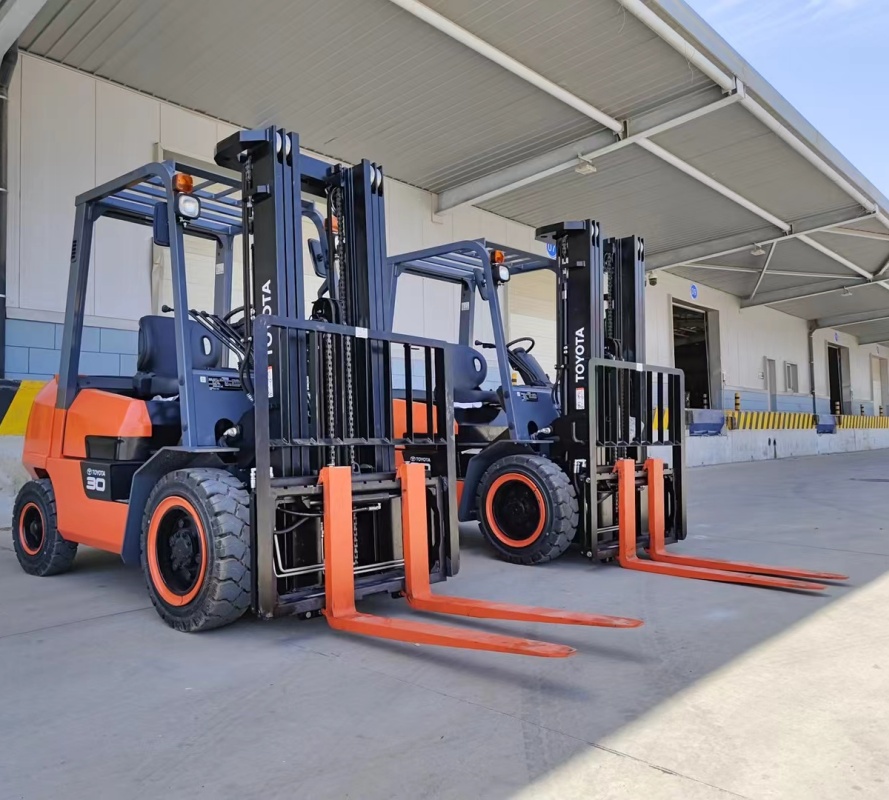
4. Used Toyota Forklift for Sale: Same Model, Very Different Value
A typical used Toyota forklift for sale listing focuses on visible data: model number, year, hours, and appearance. While these details matter, they rarely explain how the forklift will actually perform in daily operations.
Two forklifts with the same model and similar hours can show dramatically different reliability because what truly defines value is how the machine was stressed over time.
Key hidden value drivers include:
● Average load weight over time
A forklift consistently lifting 70–80% of rated capacity ages very differently from one frequently operating near its maximum limit.
● Frequency of overload operations
Occasional overloads may leave no visual trace, yet they accelerate fatigue in masts, frames, and hydraulic systems.
● Indoor vs harsh outdoor environments
Exposure to moisture, dust, uneven ground, or temperature extremes silently impacts bearings, seals, and electrical components.
● Operator training quality
Smooth operators extend equipment life; aggressive driving shortens it—even at low hour counts.
Professional buyers understand that paint and hour meters only tell how long a forklift was used, not how hard. True evaluation focuses on stress history, not cosmetics.
5. Real Warehouse Scenarios Where Used Toyota Forklifts Make More Sense
Used forklifts are often misunderstood as a compromise solution. In reality, Used Toyota Forklifts are highly effective when matched to the right operational scenarios.
They perform best in environments where tasks are stable, predictable, and repetitive—conditions where durability matters more than novelty.
Typical high-fit scenarios include:
● Standardized pallet handling
When pallet size, weight, and workflow remain consistent, used forklifts deliver identical results to new units.
● Repetitive warehouse workflows
High repetition favors proven machines that operators already understand well.
● Seasonal volume spikes
Buying new forklifts for peak seasons ties up capital. Used units provide capacity without long-term financial burden.
● Secondary facilities or satellite warehouses
These sites often prioritize reliability and cost control over cutting-edge features.
In such scenarios, new equipment rarely improves productivity enough to justify the added cost.
6. Risk Control: How Professionals Buy Used Toyota Forklifts
Professionals do not “take chances” with used equipment. They apply a structured risk-control mindset, treating Used Toyota Forklift purchasing as a systemized process.
Core risk-control actions include:
● Verifying service documentation
Regular maintenance records are often more valuable than low hour counts.
● Inspecting structural fatigue points
Key areas include mast rails, fork heels, chassis welds, and axle mounts.
● Testing hydraulics under load
Load testing reveals internal wear that idle inspections cannot.
● Ensuring parts interchangeability
Toyota's global parts compatibility significantly reduces future downtime risks.
Through this approach, uncertainty is minimized and used forklifts become predictable, controllable assets.
7. Used Toyota Forklifts vs New Forklifts: A Productivity Comparison
In real warehouse operations, productivity is driven by uptime, not purchase date. A well-maintained Used Toyota Forklift often delivers the same daily throughput as a new unit.
Operators are already familiar with the controls, maintenance teams know the systems, and parts are readily available. These factors reduce learning curves and unexpected downtime.
From a return-on-investment perspective, used forklifts frequently achieve full payback much faster than new equipment—sometimes within a single operating cycle.
8. The Long-Term Value of Choosing the Right Used Toyota Forklift
The true value of a Used Toyota Forklift is not short-term savings—it is long-term flexibility.
By reducing capital expenditure, businesses can scale fleets gradually, adapt to demand changes, and preserve cash flow for core operations. This flexibility becomes especially valuable in uncertain markets.
Choosing the right used forklift is not a cost-cutting decision—it is a strategic resource allocation choice.
Contact Us