

1. Warehouse Expansion Is No Longer the First Option—Vertical Upgrade Is
For many warehouse operators, expansion used to mean adding more floor space. Today, that option is increasingly constrained by reality. Rising land prices, limited industrial zoning, longer construction approvals, and the risk of disrupting ongoing operations make horizontal expansion slow, expensive, and uncertain.
As a result, more warehouses are shifting their upgrade strategy inward—optimizing how much they can store within the same footprint. By increasing rack height and reducing aisle width, operators can often gain 30–60% more storage capacity without moving or rebuilding. This shift, however, requires equipment that can safely and consistently operate at height and in tight spaces.
2. Why Traditional Forklifts Become the Bottleneck in High-Density Warehouses
Traditional counterbalance forklifts are built for versatility: wide aisles, ground-level handling, and mixed indoor-outdoor use. When placed into high-density warehouse layouts, their design becomes a limitation rather than an advantage.
Wide turning radii force aisle widths to remain large, directly reducing pallet positions. At higher lift heights, stability margins shrink, causing operators to slow down or avoid maximum rack levels altogether. Over time, this leads to underutilized racking, higher damage rates, and reduced throughput.
3. Toyota Reach Truck as a Core Enabler of High-Density Warehouse Design
A Toyota reach truck is not simply a narrower forklift—it is a machine designed around vertical efficiency. The moving mast allows loads to be handled without expanding turning space, while the compact chassis enables consistent operation in aisles under 3 meters.
More importantly, Toyota’s stability systems allow operators to lift and retrieve pallets at extreme heights with confidence. This means that racking plans designed on paper can actually be executed on the floor, day after day.
4. Designing the Warehouse Upgrade Around the Reach Truck—not the Other Way Around
Many warehouse upgrades fail to deliver expected ROI because equipment is treated as an afterthought. High racks are installed, aisle widths are fixed, and only then is a reach truck selected to “fit in.”
In reality, reach truck specifications—such as load capacity at height, required turning radius, and mast behavior—should define rack layout and aisle design from the beginning. A system designed this way operates faster, safer, and with less wear over time.
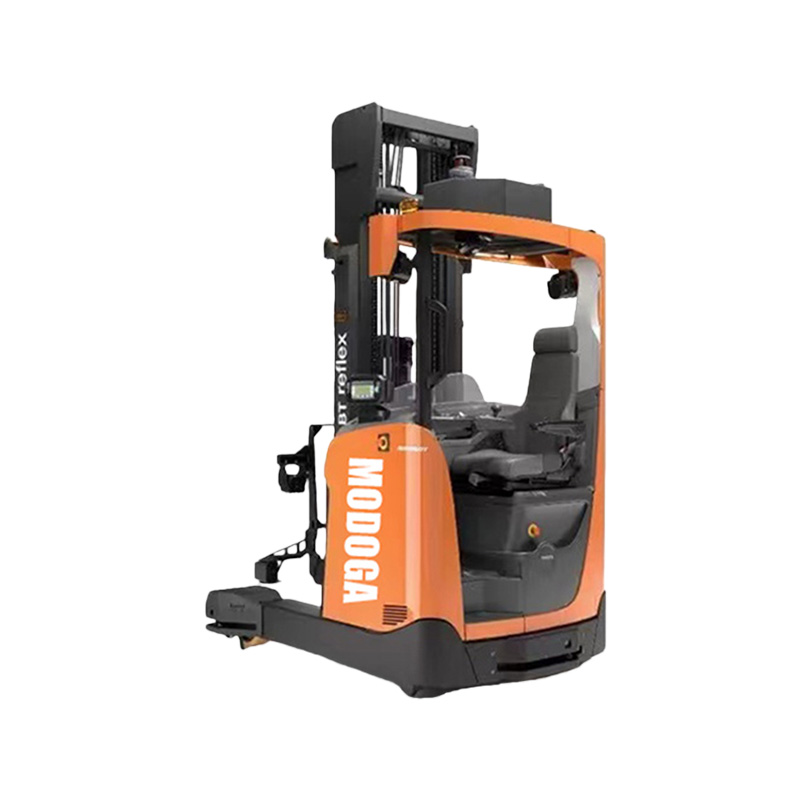
5. Toyota BT Reach Truck: Solving the Stability Challenge in Very High Racking
When rack heights push beyond 9–10 meters, small instabilities become major operational risks. Mast sway, delayed response, and reduced visibility can slow operations and increase error rates.
The BT Reflex reach truck addresses these challenges through enhanced mast rigidity, active damping, and optimized sightlines. This allows warehouses to not only build higher—but to actually use that height productively.
6. Reach Truck Toyota Price in Warehouse Upgrade Projects: Budgeting the Right Way
In warehouse upgrade projects, focusing solely on reach truck Toyota price is one of the most common budgeting mistakes. Equipment cost is visible and easy to compare, but it represents only a fraction of the economic impact of a high-density redesign.
When aisle width is reduced, the warehouse footprint required for the same inventory volume decreases. In owned facilities, this delays or eliminates the need for expansion. In rented warehouses, it directly reduces rent per pallet stored. At the same time, higher racking increases usable vertical space, while reach trucks maintain handling speed at height—lowering labor cost per pallet moved.
From a budgeting perspective, the correct question is not “How much does the reach truck cost?” but rather:
“How much space, labor, and future capital expenditure does this truck allow us to avoid?”
7. Toyota Electric Reach Truck and Sustainability in Warehouse Modernization
Modern warehouse upgrades are no longer driven solely by capacity. Energy consumption, regulatory pressure, workforce conditions, and future automation readiness are increasingly shaping equipment decisions.
Toyota electric reach trucks support these objectives in practical ways. Zero-emission operation improves indoor air quality and compliance, especially in food, pharmaceutical, and consumer goods warehouses. Lower noise levels reduce operator fatigue and make multi-shift operations more sustainable over time.
Equally important, electric reach trucks integrate easily with fleet monitoring systems, energy management platforms, and automation interfaces—making them a logical foundation for future digital or semi-automated upgrades.
8. The Importance of a Toyota Forklift Dealer in Upgrade Execution
In high-density warehouse upgrades, execution quality determines success more than theoretical design. Even a well-planned layout can fail if aisle tolerances are incorrect, operators are undertrained, or service response is slow.
An experienced Toyota forklift dealer contributes value long before the first truck is delivered—by validating aisle widths, confirming rack clearances, and aligning truck specifications with real operating conditions. After commissioning, dealer support directly affects uptime, especially during the critical early months of the upgrade.
9. When a High-Density Upgrade with Toyota Reach Truck Is Not the Right Move
Despite their advantages, reach truck–based designs are not universally optimal. Warehouses with slow inventory turnover may not benefit enough from increased density to justify the added system complexity.
Similarly, operations handling heavy, irregular, or unstable loads may face efficiency or safety challenges at height. Frequent indoor–outdoor transitions can also reduce the effectiveness of reach trucks, which are optimized for controlled indoor environments.
Recognizing these limits early prevents overinvestment and misaligned upgrades.
10. Final Framework: Is a Toyota Reach Truck–Based Upgrade Right for Your Warehouse?
A Toyota reach truck enables high-density storage, but only when deployed as part of a system. Successful warehouse upgrades align four elements:
● Space design that supports narrow aisles and height
● Equipment matched to real operating loads and cycles
● Operators trained for precision and safety
● Dealer support that sustains uptime over time
When these elements are aligned, reach truck–based upgrades deliver measurable, long-term ROI.
Contact Us