

In many fields such as warehousing logistics and industrial production, electric forklifts have become essential equipment for cargo handling and stacking due to their efficiency, convenience, and environmental friendliness. The steering angle of electric forklifts, as one of the important indicators measuring their operational performance and applicability, has a profound impact on the vehicle's operational flexibility, work efficiency, and the utilization of warehouse space.
I. Common Electric Forklifts and Their Steering Angles
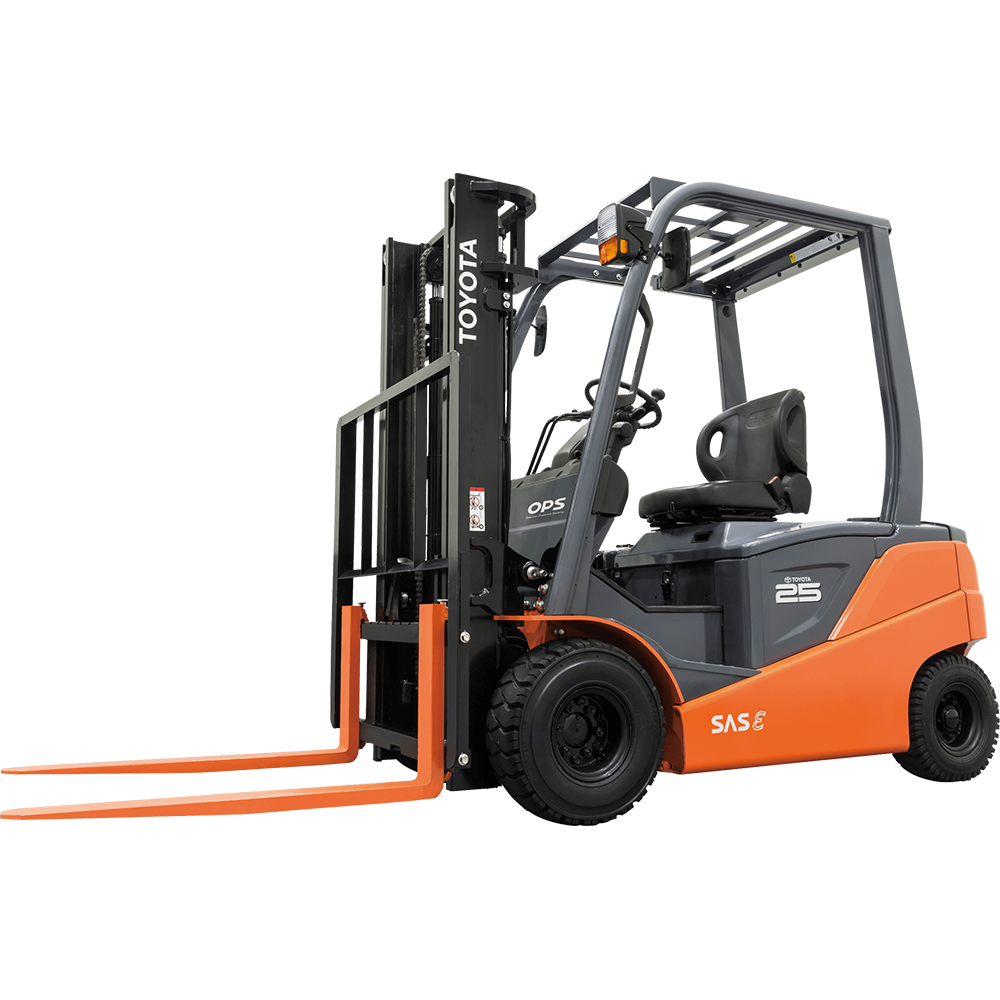
1. Four-Wheel Electric Forklift
Four-wheel electric forklifts usually have a relatively stable body structure, with a steering angle of about 60 degrees. This design allows four-wheel electric forklifts to maintain good body balance and stability during steering, making them suitable for handling and loading/unloading goods in relatively open areas such as factory workshops and warehouse passages. For example, in some large logistics distribution centers, four-wheel electric forklifts can shuttle between spacious cargo storage areas and loading platforms to complete efficient cargo transportation.
2. Three-Wheel Electric Forklift
The steering angle of three-wheel electric forklifts generally reaches about 180 degrees. This larger steering angle gives three-wheel electric forklifts higher operational flexibility. Due to their relatively compact body structure—with only one rear wheel for steering and two front wheels for driving—they can perform flexible steering movements in narrow passages. This makes three-wheel electric forklifts particularly suitable for warehousing environments with narrow passages and high cargo storage density, such as small warehouses and supermarket shelf areas, where they can achieve precise cargo handling and stacking in limited spaces and improve warehouse space utilization.
3. Sit-Down Reach Forklift
Sit-down reach forklifts have a steering angle of up to 360 degrees, offering extremely high flexibility. These forklifts are designed with forks that can move forward and backward in front of the vehicle. Combined with a large steering angle, they can pick up and place goods in 极小 (extremely small) spaces. They are mainly used in warehousing scenarios with extremely high requirements for passage width, such as high-rise shelf warehouses and narrow storage aisles. Operators can flexibly control the forklift in tight spaces to accurately place goods in designated shelf positions, greatly improving the efficiency and precision of warehousing operations.

II. Impact of Steering Angle on Operational Flexibility and Efficiency
1. Operational Flexibility
A larger steering angle means the forklift can complete steering within a smaller turning radius. For example, the 180-degree steering angle of three-wheel electric forklifts allows them to turn in narrow passages with almost no need for excessive space. Operators can easily perform in-place steering and turning without frequent complex reversing or repositioning, improving operational convenience and flexibility while reducing risks of collisions or scratches during operations to ensure the safety of goods and equipment.
2. Work Efficiency
When a forklift has a larger steering angle, it can adjust its driving direction more quickly during cargo handling, reducing waiting and stagnation time in passages due to inflexible steering. Take sit-down reach forklifts as an example: in high-rise shelf warehouses, their 360-degree steering angle allows them to quickly switch driving directions in shelf aisles and complete cargo picking and placing tasks faster. Compared to forklifts with smaller steering angles, they can significantly increase the volume of cargo processed per unit time, thereby enhancing the operational efficiency of the entire warehousing and logistics system.
III. Impact of Steering Angle on Passage Width and Warehouse Capacity
1. Passage Width
The larger the steering angle, the smaller the passage width required by the forklift. In places with limited warehouse space, this means narrower passages can be reasonably planned, leaving more space for cargo storage. For example, in some small e-commerce warehouses, using three-wheel electric forklifts (with larger steering angles) allows passage widths to be designed relatively smaller. This enables more shelves to be arranged within the limited warehouse area, improving warehouse space utilization and reducing warehousing costs.
2. Warehouse Capacity
Smaller passage widths allow more shelves and cargo storage areas to be accommodated per unit area, directly increasing warehouse capacity. Take a 1,000-square-meter warehouse as an example: using three-wheel electric forklifts (with smaller passage width requirements) can provide approximately 10%-20% more cargo storage space than using four-wheel electric forklifts (with wider passage width requirements). For enterprises, this means they can effectively increase cargo storage capacity without expanding warehouse area, meeting growing warehousing needs.
In summary, the steering angle of electric forklifts is a key factor influencing multiple aspects such as operational performance, work efficiency, and warehouse space utilization. Different types of electric forklifts have distinct steering angle characteristics, suitable for different application scenarios. During actual warehousing logistics planning and forklift selection, a deep understanding of forklift steering angles and their impacts on operations and warehousing can help enterprises better choose suitable electric forklifts based on their needs.