
Why Stability and Safety Matter More Than Price in Forklift Selection
When businesses search for a Toyota forklift for sale, the first instinct is often to compare prices, lifting capacity, or fuel type. However, the most critical factor—often overlooked—is stability and safety.
Forklift accidents are not rare. Tipping, load drops, and operator errors can lead to costly damage, injuries, or even fatalities. In this context, stability is not just a technical feature—it is a financial and operational safeguard.
Toyota forklifts have built a global reputation not simply because they are durable, but because they are engineered with safety-first principles. From structural design to intelligent control systems, every element is focused on minimizing risk and maximizing operator confidence.
Choosing a forklift is not just buying equipment—it is investing in a safer workflow.
What Makes a Toyota Forklift Stable? Core Engineering Explained
The stability of a Toyota forklift is not accidental—it is the result of precise engineering and decades of refinement.
First, Toyota designs its forklifts with a low center of gravity, which significantly reduces the risk of tipping, especially when carrying heavy loads. This is critical during turning or operating on uneven surfaces.
Second, the design of Toyota forklift forks plays a crucial role. Proper fork spacing, strength, and load distribution ensure that the weight remains balanced throughout lifting and transport.
Additionally, Toyota invests heavily in frame rigidity. A strong chassis minimizes vibration and structural deformation, ensuring consistent stability even under heavy-duty operations.
In short, stability is built into every layer of the machine—from the ground up.
Why Stability and Safety Matter More Than Price in Forklift Selection
When businesses search for a Toyota forklift for sale, the first instinct is often to compare prices, lifting capacity, or fuel type. However, the most critical factor—often overlooked—is stability and safety.
Forklift accidents are not rare. Tipping, load drops, and operator errors can lead to costly damage, injuries, or even fatalities. In this context, stability is not just a technical feature—it is a financial and operational safeguard.
Toyota forklifts have built a global reputation not simply because they are durable, but because they are engineered with safety-first principles. From structural design to intelligent control systems, every element is focused on minimizing risk and maximizing operator confidence.
Choosing a forklift is not just buying equipment—it is investing in a safer workflow.
What Makes a Toyota Forklift Stable? Core Engineering Explained
The stability of a Toyota forklift is not accidental—it is the result of precise engineering and decades of refinement.
First, Toyota designs its forklifts with a low center of gravity, which significantly reduces the risk of tipping, especially when carrying heavy loads.
Second, the design of Toyota forklift forks ensures optimal load distribution. Proper spacing and high-strength materials prevent imbalance during lifting.
Additionally, the rigid frame structure enhances durability and minimizes vibration, allowing consistent performance even in demanding environments.
In essence, stability is not a feature—it is a system built into every component.
Toyota Active Stability System (SAS): The Game Changer
One of the defining features of a Toyota forklift is the System of Active Stability (SAS)—a technology that fundamentally changes how forklifts handle risk.
SAS continuously monitors key parameters such as load weight, lift height, and steering angle. Based on real-time data, it automatically adjusts the forklift's behavior.
For example, it can limit tilt angles, stabilize the mast, and control speed during turns. This significantly reduces the likelihood of tipping, especially in high-risk operations.
More importantly, SAS compensates for human error. Even experienced operators can make mistakes under pressure, but SAS acts as a safety net that keeps operations under control.
Comparing Stability Across Toyota Forklift Types
Different Toyota forklift types offer varying stability advantages depending on their application.
Electric forklifts are designed for precision. Their battery placement lowers the center of gravity, making them extremely stable for indoor operations.
Internal combustion forklifts, on the other hand, are built for rugged environments. They offer strong traction and stability on uneven terrain.
The key is not which type is better—but which type is better for your specific working conditions.
Comparing Stability Across Toyota Forklift Types
When evaluating Toyota forklift types, stability is not a one-size-fits-all feature—it is engineered differently across each category to match specific applications. Toyota offers one of the most complete forklift lineups in the industry, and each type delivers stability in its own way.
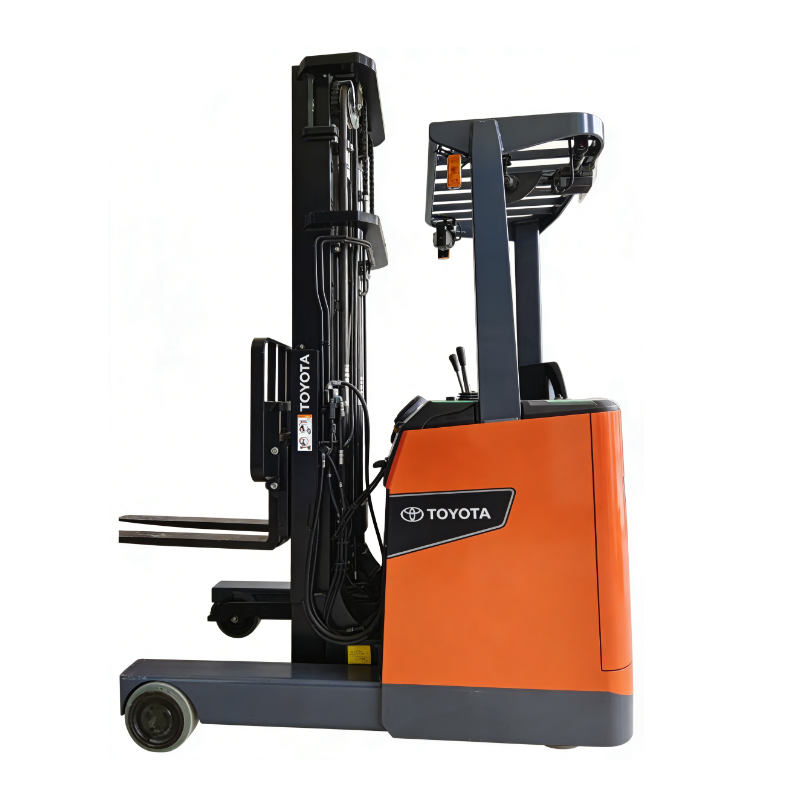
Electric Counterbalance Forklifts (3-Wheel & 4-Wheel)
These are the most widely used Toyota forklift types for indoor operations.
Stability characteristics:
● Battery positioned at the bottom lowers the center of gravity
● 4-wheel models provide maximum balance for heavier loads
● 3-wheel models offer tighter turning radius with slightly reduced lateral stability
Best for: Warehouses, logistics centers, narrow aisles
Key advantage: High precision + excellent stability on flat surfaces
Internal Combustion Counterbalance Forklifts (Diesel / LPG / Gasoline)
These are the classic heavy-duty Toyota forklift models for outdoor use.
Stability characteristics:
● Heavier chassis improves ground grip
● Strong traction ensures stability on uneven terrain
● Designed to handle high loads without tipping
Best for: Construction sites, ports, yards
Key advantage: Stable under heavy load and rough conditions
Reach Trucks
Reach trucks are specialized for vertical stacking and high-density storage.
Stability characteristics:
● Extendable mast shifts load forward, requiring advanced balance control
● Equipped with electronic stabilization systems
● Narrow body improves aisle maneuverability but requires controlled operation
Best for: High-racking warehouses
Key advantage: Stable at height with precision control
Pallet Jacks (Electric & Manual)
These are entry-level Toyota forklift types used for short-distance transport.
Stability characteristics:
● Low lifting height reduces tipping risk
● Wide fork base improves load balance
● Limited speed enhances operational safety
Best for: Retail, supermarkets, short-distance handling
Key advantage: Simple, safe, and stable for light-duty use
Stackers (Walkie & Ride-On)
Stackers bridge the gap between pallet jacks and forklifts.
Stability characteristics:
● Compact design with low center of gravity
● Stabilizing legs support vertical lifting
● Suitable for moderate height stacking
Best for: Small warehouses, light industrial use
Key advantage: Stable vertical lifting in confined spaces
Order Pickers
Designed for picking individual items rather than full pallets.
Stability characteristics:
● Operator rises with the platform, requiring enhanced safety controls
● Speed and lift height are electronically limited
● Anti-tip systems ensure stability during elevation
Best for: E-commerce, parts warehouses
Key advantage: Safe and stable human-machine integration
Rough Terrain Forklifts
Built for extreme outdoor environments.
Stability characteristics:
● Large tires and high ground clearance
● Reinforced frame for uneven surfaces
● Advanced suspension systems improve balance
Best for: Construction, agriculture
Key advantage: Maximum stability on rough and uneven ground
Tow Tractors & Tuggers
Not traditional lifting forklifts but part of Toyota's material handling range.
Stability characteristics:
● Low center of gravity for towing stability
● Designed for controlled movement rather than lifting
● High braking efficiency ensures safety under load
Best for: Manufacturing lines, airports
Key advantage: Stable horizontal transport
Automated Guided Vehicles (AGVs)
Toyota also offers automated Toyota forklift types for smart warehouses.
Stability characteristics:
● AI-controlled movement eliminates human error
● Sensors ensure load balance and obstacle avoidance
● Consistent, repeatable operation improves safety
Best for: Automated logistics systems
Key advantage: Highest level of operational stability and safety
Choosing the Right Toyota Forklift Type Based on Stability Needs
Instead of asking “which Toyota forklift is most stable,” the better question is:
Which forklift is most stable for your environment?
● Indoor + precision → Electric forklifts
● Outdoor + heavy duty → IC forklifts
● High stacking → Reach trucks
● Light handling → Pallet jacks or stackers
● Automation → AGVs
Each type is engineered with a different definition of stability—matching machine design to real-world conditions.
Safety Features That Define Toyota Forklifts
Toyota forklifts are equipped with multiple safety systems beyond stability.
The Operator Presence Sensing System (OPSS) ensures the forklift only operates when the driver is properly seated.
Anti-rollback systems prevent backward movement on slopes, while optimized mast design improves visibility, reducing blind spots.
Emergency shut-off controls add another layer of protection, allowing quick response in critical situations.
Together, these features create a comprehensive safety ecosystem.
Long-Term Reliability and Maintenance Impact on Safety
Safety is not only about design—it also depends on long-term reliability.
Toyota forklifts are known for their durability, often operating reliably for 5–8 years or more.
However, maintenance plays a critical role. Poor maintenance increases the risk of mechanical failure.
Choosing a professional Toyota forklift supplier ensures access to genuine parts and proper service support.
Buying Advice: How to Choose the Safest Toyota Forklift for Your Business
When working with a Toyota forklift dealer, focus on safety-related questions.
Ask about maintenance history, SAS functionality, and component condition—especially when buying used equipment.
Always inspect forks, brakes, and control systems before making a decision.
A safe forklift is not just about brand—it is about condition and suitability.
Conclusion: Is Toyota the Safest Forklift Brand?
Toyota forklifts stand out as one of the safest options in the industry due to their advanced engineering, intelligent systems, and long-term reliability.
While no machine is completely risk-free, Toyota significantly reduces operational hazards through design and technology.
For businesses prioritizing safety, a Toyota forklift for sale is not just a purchase—it is a strategic decision.
Contact Us