

6. Radio Shuttle Racking as a Step Toward Automation (Not a Final Destination)
Many warehouses think about automation in extremes:
either stick with fully manual forklifts or leap straight to fully automated AS/RS systems.
Radio Shuttle Racking offers a middle ground—sometimes called the “semi-automated bridge”.
Why It Works as a Transition
① Lower upfront investment than full AS/RS
Full automation can be cost-prohibitive, especially for medium-sized warehouses.
A radio shuttle racking system delivers partial automation at a fraction of the cost.
② Operational familiarity
Operators still use forklifts at lane entrances, so workflows remain intuitive.
This reduces training time and change resistance.
③ Scalable and adaptable
Shuttles can later integrate with conveyor systems, warehouse management software, or AGVs.
The system grows with operational needs rather than forcing a full overhaul.
Strategic Advantages for Warehouse Planning
● Test automation ROI before committing fully:
Managers can measure labor savings, throughput gains, and space utilization improvements.
● Prepare the workforce gradually:
Teams learn to interact with automated systems without being overwhelmed.
● Mitigate risks of technology adoption:
Any issues affect only part of the workflow, not the entire warehouse operation.
The Big Picture
Think of Radio Shuttle Racking as a training ground for your warehouse:
● Pallets move systematically
● Operators interact with machines in a controlled way
● Warehouse managers gather data and insights
By the time full automation is considered, the warehouse has already learned to operate in a semi-automated environment—making the transition smoother, faster, and less risky.
7. Cost Structure: What You're Really Paying for in a Shuttle Radio Racking System
Many buyers ask, “How much does a Radio Shuttle Racking system cost?”
But price alone doesn’t tell the story.
The real question is: what are you paying for, and what value does it deliver?
1. Hardware: The Physical Infrastructure
This includes:
● Steel frames, beams, and supports
● Radio shuttles themselves
● Rails, guides, and safety mechanisms
It's easy to focus on the cost of steel and machines, but the design and quality determine long-term durability and operational reliability.
2. Software and Control Systems
A shuttle is only as smart as its software:
● Movement logic (FIFO/LIFO rules)
● Lane occupancy tracking
● Integration with WMS (Warehouse Management System)
Investing in software ensures repeatable, predictable operations, which is often the hidden value behind the upfront cost.
3. Installation and Engineering Services
Proper layout design, safety compliance, and initial setup are critical.
Poor installation can result in:
● Frequent errors
● Downtime
● Reduced throughput
This is why installation and engineering are a significant component of the total investment.
4. Training and Change Management
Even semi-automated systems require human interaction.
Operators must learn:
● How to interface with shuttles
● Emergency procedures
● Best practices for lane management
This training cost is part of the system's ROI—it ensures safety, speed, and reliability.
5. Operational Savings: The Other Side of the Cost
While these are upfront costs, the returns come in:
● Reduced forklift travel and labor
● Higher storage density per square meter
● Lower error rates
● Predictable throughput
Viewed this way, every dollar spent contributes to both capacity and operational efficiency.
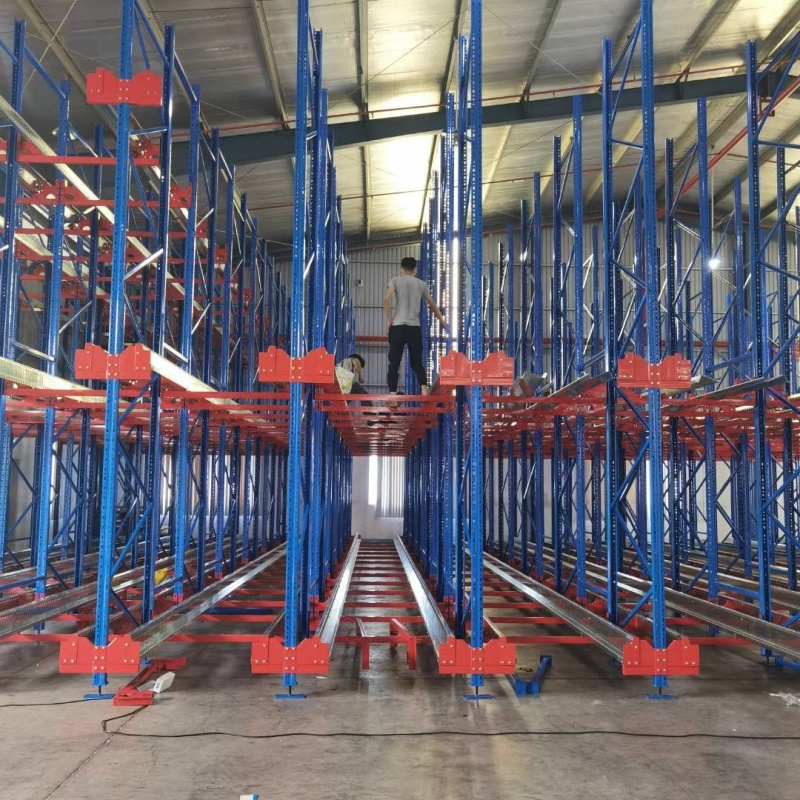
8. Typical Industries Using Radio Shuttle Racking (and Why They Chose It)
Radio Shuttle Racking is not for every warehouse—but certain industries find it almost indispensable.
Here's why some sectors adopt it.
1. Cold Chain and Frozen Food Warehouses
Challenges:
● Limited temperature-controlled space
● High-density storage required
● Labor scarcity and high turnover
Why Radio Shuttle Racking?
● Deep-lane storage maximizes cubic utilization
● Reduced forklift travel minimizes energy loss in cold storage
● FIFO support ensures product freshness
For frozen food distributors, a radio shuttle pallet racking system is often the difference between profit and waste.
2. Third-Party Logistics (3PL) Centers
Challenges:
● Handling multiple clients with varying SKUs
● Fast, reliable throughput required
● Seasonal demand spikes
Why Radio Shuttle Racking?
● Shuttles manage repetitive SKU flows efficiently
● Reduced forklift congestion improves reliability
● Scalable design adapts to fluctuating volumes
Many 3PL operators see it as a flexible automation layer without committing to full AS/RS.
3. E-Commerce Fulfillment Centers
Challenges:
● High SKU variety with frequent small orders
● Tight delivery windows
● Labor-intensive picking operations
Why Radio Shuttle Racking?
● Lanes can handle bulk storage for high-turn SKUs
● Shuttles reduce forklift handling, letting staff focus on order picking
● Integrates with WMS to streamline SKU rotation
E-commerce warehouses benefit from predictable throughput without fully automated investment.
4. Manufacturing and Heavy Industry Storage
Challenges:
● Large pallets of raw materials
● Deep storage required
● Safety risks with heavy loads
Why Radio Shuttle Racking?
● Controlled movement reduces human error
● Deep-lane storage frees floor space
● Makes large-scale inventory manageable
For manufacturers, radio shuttle racking is often a safer, more efficient alternative to conventional high-density racks.
9. Common Mistakes to Avoid When Implementing a Radio Shuttle Racking System
Deploying a Radio Shuttle Racking system isn’t just buying hardware and putting it in a warehouse.
Many projects fail or underperform because of avoidable mistakes.
Here are the most common pitfalls.
1. Underestimating Layout Complexity
Mistake: Simply mirroring your old rack layout.
Reality: Shuttles require precise lane alignment, smooth rails, and safety zones.
Ignoring this can lead to:
● Frequent shuttle stops
● Increased maintenance
● Reduced throughput
Tip: Engage an experienced engineer to design the layout according to lane depth, pallet size, and workflow logic.
2. Skipping Software and Integration Planning
Mistake: Installing shuttles without integrating with WMS or ERP.
Reality: A radio shuttle is smart, but it cannot manage inventory decisions alone.
Without integration:
● FIFO/LIFO rules may not be enforced
● Pallet tracking errors increase
● Operators lose trust in the system
Tip: Plan software integration before hardware installation to ensure smooth operations from day one.
3. Ignoring Operator Training
Mistake: Assuming operators can learn on the fly.
Reality: Even semi-automated systems require new skills:
● Interface with the shuttle
● Emergency handling
● Lane-specific loading and unloading
Skipping training increases errors, downtime, and safety risks.
Tip: Conduct structured training and provide operational manuals.
4. Choosing Cost Over Quality
Mistake: Selecting the cheapest shuttles or components.
Reality: Lower-quality shuttles may break down frequently, causing downtime and hidden costs.
Tip: Evaluate durability, warranty, and support, not just upfront price.
5. Ignoring Maintenance Planning
Mistake: Failing to plan preventive maintenance.
Reality: Radio shuttles need regular inspections, rail cleaning, and battery checks.
Neglect leads to:
● Reduced lifespan
● Unexpected failures
● Increased operational risk
Tip: Include maintenance schedule and spare parts plan in the deployment plan.
10. Future Trends: The Role of Radio Shuttle Racking in Smart Warehouses
As warehouses embrace Industry 4.0 and smart logistics, Radio Shuttle Racking is evolving—not just as a storage solution, but as a data-driven operational layer.
1. Integration with WMS and IoT Devices
Modern warehouses are increasingly interconnected.
● Sensors on shuttles track position, movement, and maintenance needs.
● Data feeds into Warehouse Management Systems (WMS) for real-time visibility and predictive planning.
This means radio shuttle pallet racking is no longer passive—it becomes an active component of operational intelligence.
2. Semi-Automated Systems as a Gateway to Full Automation
Many companies use radio shuttles as a strategic stepping stone:
● Operators maintain control at lane entrances
● Shuttles handle repetitive deep-lane movements
● Data collected can inform future AGV or conveyor integration
This staged approach reduces risk, controls costs, and prepares staff for more advanced automation.
3. Advanced Analytics and AI Optimization
Future trends include:
● AI predicting peak activity times and optimal pallet placement
● Machine learning algorithms adjusting shuttle schedules to maximize throughput and minimize wear
Radio shuttle racking systems thus become smarter over time, improving ROI without hardware replacement.
4. Sustainability and Energy Efficiency
By reducing unnecessary forklift travel and optimizing warehouse space:
● Energy consumption decreases
● CO2 footprint is reduced
● Operations become greener and more cost-efficient
For environmentally-conscious companies, radio shuttle systems offer both operational and sustainability benefits.
Conclusion: Strategic, Data-Driven, and Future-Proof
Radio Shuttle Racking is no longer just “a high-density storage solution.”
It is a semi-automated, data-integrated, and scalable layer that prepares warehouses for next-generation logistics.
Forward-thinking warehouses see it as a bridge from manual operations to fully automated, smart warehouses, balancing investment, efficiency, and risk.