
Section 1|The Real Problem Warehouses Face: Space Is Expensive, Time Is Limited
Before any discussion about Drive-Through Pallet Rack, it is worth asking a more fundamental question:
What problem are warehouses really trying to solve today?
The answer is no longer just “how to store pallets.”
Modern warehouses face three simultaneous pressures:
① Rising warehouse space costs
Whether in urban logistics centers or industrial zones, warehouse space has become one of the most expensive fixed costs.
② Increasing SKU concentration
Many warehouses store large quantities of the same product, often with minimal variation.
③ Limited tolerance for inefficiency
Labor costs are rising, and forklifts, operators, and floor space must be used with maximum efficiency.
This is exactly where a drive-through racking system begins to make sense—not as a storage structure, but as a response to economic pressure.
Unlike selective racking, drive-through racking sacrifices direct pallet access in exchange for something far more valuable:
maximum space utilization per cubic meter.
When space becomes the bottleneck, not access speed, the logic of drive in drive through racking suddenly becomes very rational.
Section 2|What Is Drive-Through Pallet Rack—Explained Through Use Scenarios, Not Definitions
Imagine a cold storage warehouse handling frozen meat or ice cream.
The product range is narrow—perhaps only 20 to 30 SKUs—but each SKU occupies hundreds or even thousands of pallets at any given time.
In this environment, selective pallet racking creates a hidden inefficiency.
Wide aisles are built to access pallets that rarely change position. Space is sacrificed not for operational necessity, but for a level of selectivity that adds little value.
This is where a Drive-Through Pallet Rack fundamentally changes the equation.
Instead of designing the warehouse around forklift aisles, a drive-through racking system designs storage lanes around pallet volume. Forklifts drive directly into the rack structure, guided by rails, placing pallets in deep lanes that may extend several positions back.
The goal is not speed—it is density.
By removing internal aisles, drive-through racking dramatically increases pallet positions within the same footprint. For warehouses where product turnover happens by SKU rather than by individual pallet, this trade-off is logical and efficient.
What matters here is not “easy access,” but predictable flow.
When pallets move in large batches, volume efficiency outweighs pallet-level visibility.
In short, drive-through racking is not about storing more types of products—it is about storing the same products better.
Section 3|Drive-In vs Drive-Through Racking: The Difference That Actually Matters
At first glance, Drive-In and Drive-Through Racking appear nearly identical.
Both fall under the broader category of drive-in drive-through racking, using deep lanes and eliminating aisles to maximize storage density.
However, the real distinction is not mechanical—it is operational.
Drive-In racking uses a single entry point. Forklifts enter and exit from the same side, which naturally results in a LIFO (Last In, First Out) inventory flow. This works well for products with no expiration concerns or where rotation is not critical.
Drive-Through racking, by contrast, allows forklifts to enter from one side and exit from the opposite side. This enables a FIFO (First In, First Out) flow, making it suitable for food, beverage, and time-sensitive goods.
The difference seems simple, but the consequences are significant.
Choosing drive-through racking imposes inventory discipline.
Pallet flow must be planned. Inbound and outbound operations must be coordinated. But in return, the system protects product freshness and reduces write-offs.
In long-term operations, especially in regulated industries, drive-through racking is often the safer strategic choice, even if the initial investment is slightly higher.
Section 4|When Drive-Through Racking Becomes a Competitive Advantage
Drive-through racking is not universally superior.
Its strength appears only under the right operational conditions.
It performs best when product variety is limited, but pallet volume per SKU is high. In such cases, storage density directly impacts profitability.
Another key factor is cost structure.
When warehouse space is expensive—such as in cold storage or urban facilities—every square meter saved reduces long-term operating cost.
Drive-through pallet rack systems also favor operations where picking speed is secondary to storage efficiency. If pallets move in full loads rather than mixed orders, reduced selectivity is not a drawback.
Under these conditions, drive-through racking does more than store pallets—it lowers the cost per pallet per day.
This is why some warehouses quietly outperform competitors without expanding their footprint.
They are not working harder—they are storing smarter.
Section 5|Industries That Quietly Rely on Drive-Through Pallet Rack
Many of the industries that rely most heavily on Drive-Through Pallet Rack rarely advertise it.
The system operates quietly in the background, supporting stable, high-volume storage without drawing attention to itself.
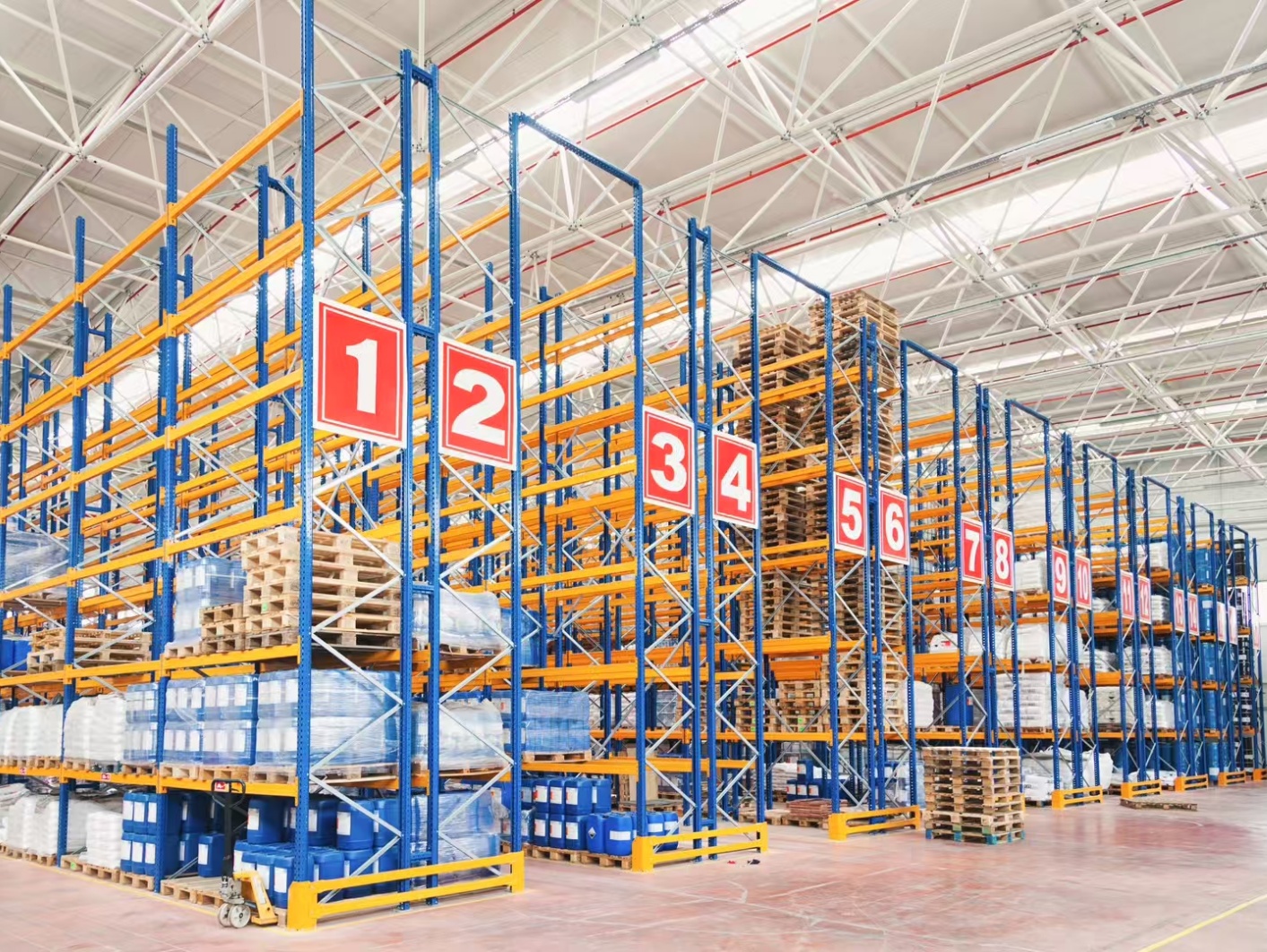
Cold storage is the most obvious example. Frozen food warehouses prioritize temperature control and space efficiency above all else. Every unnecessary aisle increases refrigeration volume and energy cost. A drive-through racking system minimizes air space while maximizing pallet density, directly reducing long-term operating expenses.
Beverage and bottling plants follow a similar logic. Products are produced in large batches with minimal variation. Pallets often remain untouched until shipping. Here, drive-through racking supports predictable flows rather than rapid picking.
Dairy and meat processing facilities also favor FIFO-driven storage. Product rotation is critical, but SKU diversity is limited. Drive in drive through racking allows these facilities to maintain strict rotation without sacrificing density.
Even chemical and raw material warehouses benefit from drive-through pallet rack systems. Safety regulations often limit handling frequency. Storing materials in deep, controlled lanes reduces unnecessary movement and exposure.
What unites these industries is not their products—but their storage behavior.
They value stability, volume consistency, and cost control over flexibility.
For such operations, drive-through racking is not a special solution.
It is simply the most logical one.
Section 6|Operational Trade-Offs: What You Gain and What You Must Accept
High-density storage always comes with trade-offs, and drive-through racking is no exception.
The most obvious gain is storage density. By eliminating aisles, warehouses can store significantly more pallets within the same footprint. This directly reduces storage cost per unit.
Another advantage is simplified inventory logic. When pallets move in batches, managing inventory by lane rather than by position can actually reduce complexity.
However, these gains require acceptance of certain limitations.
Selectivity is reduced. Individual pallets are not immediately accessible, making drive-through racking unsuitable for mixed picking environments.
Picking speed may also decline. Forklifts must enter lanes carefully, which slows down operations compared to open aisle systems.
Perhaps most importantly, forklift skill and discipline become critical.
Poor driving causes rack damage. Poor inventory discipline breaks FIFO flow.
A drive-through racking system does not tolerate improvisation.
It rewards structured processes—and exposes weaknesses in chaotic operations.
Section 7|Designing a Drive-Through Racking System That Actually Works
The success of a drive-through pallet rack system is determined long before installation—during design.
Lane depth must match inventory behavior. Too shallow wastes potential; too deep creates congestion and risk.
Pallet consistency is equally critical. Variations in pallet size or quality increase the chance of misplacement and rack damage.
Forklift clearance, guide rails, and entry protection should be designed around real operating conditions—not theoretical dimensions.
Load distribution also matters. Uprights and rails must be engineered for uneven loading, not ideal scenarios.
Finally, consider future flexibility. Even in stable operations, SKUs change. A well-designed drive-through racking system allows limited adaptation without full replacement.
Good design turns drive-through racking into a long-term asset.
Poor design turns it into a bottleneck.
Section 8|Safety, Maintenance, and Long-Term Cost Considerations
Because forklifts operate inside the rack structure, safety is central to drive-through racking.
Proper operator training is essential. Drivers must understand lane alignment, speed control, and load placement.
Rack protection systems—such as upright guards and end-of-lane barriers—dramatically reduce long-term damage.
Regular inspections are not optional. Minor misalignments, if ignored, escalate into structural failures.
From a cost perspective, a well-maintained drive-through pallet rack often outperforms cheaper alternatives over time.
Lower repair rates, longer service life, and reduced downtime offset higher upfront investment.
The true cost of drive-through racking is not purchase price—it is lifecycle performance.
Section 9|Is Drive-Through Pallet Rack Right for Your Warehouse?
Before choosing drive-through racking, warehouses should ask honest questions.
Do you store large quantities of identical products for extended periods?
Is storage density more critical than fast, mixed picking?
Can your operation enforce FIFO consistently?
Are forklift operators trained and supervised?
If the answer to most of these questions is yes, drive through pallet rack deserves serious evaluation.
If not, forcing the system into an unsuitable environment will create friction rather than efficiency.
Drive-through racking is not a shortcut.
It is a strategic alignment between space, inventory, and discipline.