

1. The Hidden Crisis in Modern Warehousing: Space Is No Longer Cheap
Warehousing has entered a period where space efficiency is no longer a secondary concern—it has become a strategic priority. Across logistics, manufacturing, and distribution sectors, warehouses are under pressure from multiple directions at once. Land prices continue to rise, especially near urban and port areas. At the same time, labor shortages and higher wages are pushing companies to extract more value from existing facilities rather than expanding outward.
Traditional warehouse layouts were designed for flexibility and simplicity. Wide aisles allowed conventional forklifts to move freely, but they also consumed a significant portion of the total floor area. In today's environment, that “unused” aisle space represents locked-up capital and missed capacity.
This is where Very Narrow Aisle Racking changes the conversation. Instead of asking, “How much can we store?” the better question becomes, “How intelligently are we using the space we already have?” Very narrow aisle solutions respond directly to this challenge by reclaiming aisle space and converting it into vertical storage capacity.
More importantly, VNA systems align with a broader shift in warehouse strategy—from expansion-driven growth to optimization-driven growth. Rather than building new facilities, companies are redesigning existing warehouses into high-density, high-efficiency environments. In this context, Very Narrow Aisle Racking is not a cost-saving tactic; it is a structural response to a new economic reality in warehousing.
2. What Is Very Narrow Aisle Racking—Beyond a Simple Rack Definition
Very Narrow Aisle Racking is often misunderstood as a specific rack configuration defined by narrow aisle widths. In reality, this definition is incomplete. A very narrow aisle racking system should be understood as an integrated storage concept that combines infrastructure, equipment, and operational logic.
At its core, VNA racking reduces aisle width to the minimum required for specialized handling equipment. This allows warehouses to install more rack rows within the same footprint and significantly increase pallet positions. However, the true value of VNA lies not in the racks themselves, but in how the entire system functions together.
Unlike conventional racking, VNA solutions depend heavily on guided material handling—such as wire-guided or rail-guided turret trucks. These systems eliminate unnecessary maneuvering, reduce operator error, and enable safe operation at extreme heights. As a result, VNA racking is inseparable from the warehouse's material flow design.
This is why treating Very Narrow Aisle Racking as a “product purchase” often leads to disappointing results. Successful implementations approach it as a warehouse redesign project. Layout planning, rack engineering, equipment selection, safety systems, and operator training must all be considered together.
In short, Very Narrow Aisle Racking is not about installing narrower aisles—it is about redesigning how a warehouse stores, moves, and manages inventory as a coordinated system.
3. From “Narrow” to “Very Narrow”: Why the Difference Changes Everything
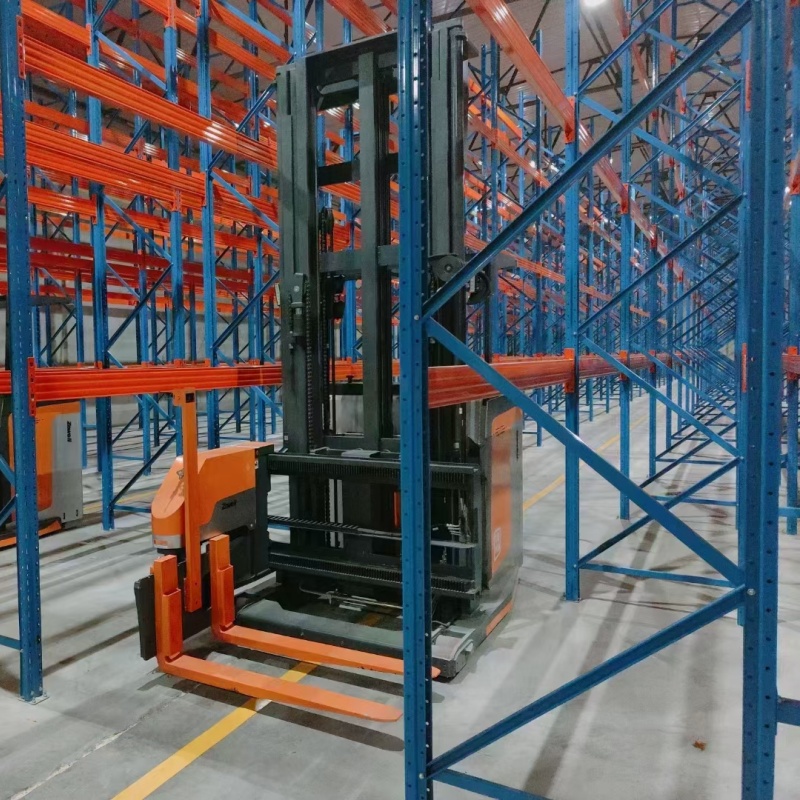
At first glance, the transition from a narrow aisle racking system to a VNA very narrow aisle solution may appear minimal—a difference of only a few hundred millimeters in aisle width. Yet this incremental change triggers a fundamental shift in warehouse design and operations.
In narrow aisle systems, conventional forklifts still operate, and aisle widths allow some lateral flexibility. Very Narrow Aisle Racking, however, requires specialized turret trucks or automated guided vehicles (AGVs) that can operate safely in aisles as narrow as 1.2 meters or less. This enables higher density layouts, often increasing storage capacity by 30–50%.
Beyond equipment, VNA influences vertical storage strategy. Narrow aisles often limit rack height due to visibility and safety constraints. VNA systems, paired with guided trucks, allow safe operation at greater heights, unlocking cubic storage potential. Additionally, flow planning, picking paths, and load sequencing all change in a VNA environment.
The key takeaway is that moving to very narrow aisles is not just a matter of space saving—it fundamentally alters warehouse workflows, equipment requirements, and operational logic. Companies must rethink how pallets move, how orders are picked, and how inventory is managed to realize the full benefit of VNA.
4. Inside a Very Narrow Aisle Warehouse: How Space Is Re-engineered
A very narrow aisle warehouse is fundamentally different from a conventional facility. Every element—from aisle width and rack height to pallet orientation—is optimized in an integrated manner. The goal is to maximize usable storage density without compromising safety or accessibility.
VNA layouts often reduce aisle widths by 30–50% compared to narrow aisle warehouses. This freed space allows additional rack rows or higher vertical stacking. Pallet orientation may shift from conventional front-facing layouts to configurations optimized for turret truck access. Even the warehouse floor itself is rethought: traffic patterns, staging areas, and picking zones are reorganized to complement high-density storage.
The impact on workflow is profound. With VNA very narrow aisle racking, picking routes are shorter, congestion is minimized, and operators can access multiple levels safely. Guided trucks reduce human error and enable higher stacking heights than would be feasible in a traditional layout.
Ultimately, a very narrow aisle warehouse is a re-engineered environment, where storage, equipment, and operations function as a cohesive system. It's not just about fitting more pallets; it's about creating an optimized warehouse ecosystem that aligns space, safety, and operational efficiency.
5. The Role of Equipment: Why VNA Racking Never Works Alone
One of the most common mistakes in implementing Very Narrow Aisle Racking is treating it as a standalone product. In reality, VNA systems rely heavily on specialized equipment. Without the right forklifts, guidance systems, or semi-automation, even the densest VNA layout cannot deliver promised efficiency.
Specialized VNA turret trucks or wire-guided forklifts are designed to operate in aisles as narrow as 1.2 meters while reaching heights of 12 meters or more. They minimize lateral movement, reduce pallet damage, and maintain safe operation in compact spaces. Some advanced warehouses integrate AGVs or automated cranes to further optimize movement and reduce human intervention.
The equipment also drives operational efficiency. Faster retrieval times, more accurate picking, and reduced congestion translate into higher throughput per square meter. Safety is also improved, as guided vehicles reduce collisions in tight aisles.
In short, a very narrow aisle racking system is only as effective as the equipment and operational workflow that support it. Installing VNA racks without considering these factors is like buying a race car but never filling it with fuel—it simply cannot perform.
6. Operational Impact: What Changes After You Switch to VNA
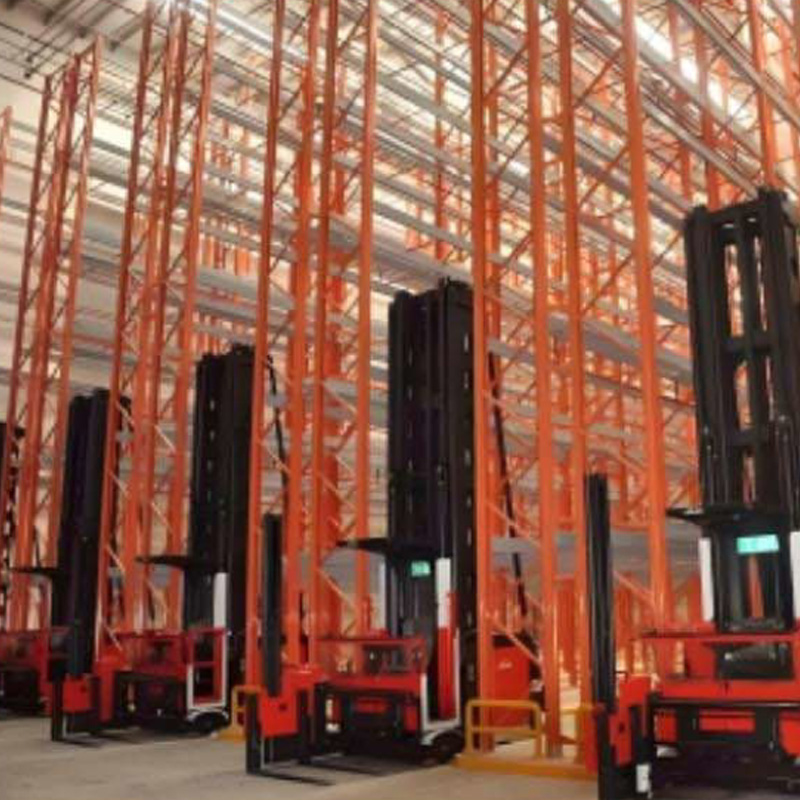
Switching to a VNA very narrow aisle system impacts every aspect of warehouse operations. Storage density increases dramatically, allowing more SKUs or higher inventory volumes without additional space. Picking accuracy improves as guided trucks or semi-automated systems reduce human error. Travel time per pick decreases, leading to higher throughput.
Moreover, VNA systems improve safety. With reduced manual maneuvering, fewer collisions and accidents occur. Operators can work in tighter spaces with confidence, even at extreme heights. Reduced congestion also minimizes downtime and bottlenecks.
Cost efficiency improves over time. While initial investment in specialized racks and equipment is higher than conventional systems, the long-term ROI is often faster due to increased storage, reduced labor costs, and better space utilization. Many companies report a 20–40% increase in storage capacity and 15–30% improvement in operational throughput after VNA adoption.
Finally, VNA racking encourages a mindset of system-level thinking. Warehouse managers begin to design not only for today’s storage needs but also for future automation, scalability, and high-density logistics. It's a transformation from reactive to proactive warehouse management.
7. Is Very Narrow Aisle Racking Right for Every Warehouse?
Despite its benefits, VNA very narrow aisle racking is not universally suitable. High-density storage works best when pallet movements are predictable, inventory turnover is moderate to high, and specialized equipment is feasible. Warehouses with extremely variable loads, irregular pallet sizes, or low ceiling heights may struggle to justify the investment.
Space utilization alone is not enough. VNA adoption requires operational discipline, trained staff, and sometimes automation. The best candidates are warehouses planning for long-term growth, where maximizing cubic storage and preparing for future automation yields a measurable ROI.
Cost is another factor. While VNA can reduce long-term labor and space costs, the upfront expense for racks, guided vehicles, and safety systems is higher. Small or temporary warehouses may not benefit enough to offset this initial investment.
In summary, companies must evaluate workflow complexity, vertical space, inventory characteristics, and growth plans before committing. VNA is a strategic choice, not a universal fix.
8. Designing a Future-Ready Narrow and Very Narrow Aisle Racking System
Designing a future-ready narrow and very narrow aisle racking system goes beyond rack dimensions. It involves planning for automation, scalability, safety, and operational flexibility. Early integration of automated guided vehicles (AGVs) or semi-automation ensures that the warehouse can scale without costly redesigns.
Vertical space must be optimized. Modern VNA racks often exceed 10–12 meters, requiring careful calculation of load capacities, clearances, and fire safety regulations. Guidance systems, sensors, and traffic management must all be considered from the start to avoid retrofitting costs.
Safety is paramount. Narrow aisles increase the potential for collisions if guidance or workflow systems are inadequate. Designing for safe human-machine interaction ensures both high efficiency and low risk.
Finally, future-ready VNA systems should consider data integration. Warehouse Management Systems (WMS) and automation software must communicate with rack layout and equipment to optimize throughput, track inventory in real-time, and enable predictive maintenance.
9. Conclusion: VNA Is Not About Racks—It's About Decisions
Very Narrow Aisle Racking is more than a storage solution—it is a strategic decision. It challenges companies to rethink space, workflow, equipment, and long-term growth. VNA success depends on system-level thinking, not just installing narrower aisles.
When implemented correctly, VNA transforms warehouse efficiency, safety, and storage density. It aligns with modern logistics trends: automation, high-density storage, and optimized labor utilization. Companies that treat VNA as a standalone product, rather than a holistic warehouse redesign, risk underperforming and wasting investment.
The ultimate lesson is that every aspect of a VNA warehouse—from layout to equipment, from workflow to software—must work together. It is an ecosystem, not a product. With proper planning, VNA provides measurable ROI, future-proof scalability, and a strategic competitive advantage.
Contact Us