
Introduction
Selecting the right forklift is not just about buying lifting equipment — it’s about matching machine capability to your operational demands, safety requirements, and total cost of ownership. As a trusted toyota forklift dealer and specialist in toyota material handling solutions, we’ll walk you step-by-step through the decision factors that determine whether a Toyota 9 series forklift or a compact toyota 5 series forklift is the right fit for your business.
1. Start with what you need: applications & environment
Before comparing models, define where and how the forklift will work.
-
Indoor vs outdoor: Outdoor yards and uneven surfaces usually require stronger suspension and pneumatic tires (commonly found on higher-capacity Toyota models). Indoor operations, especially in narrow aisles, favor electric or cushion-tyred models like those in the toyota 6 series forklift or toyota 5 series forklift range.
-
Temperature and contamination: Cold-storage or corrosive environments may require specialized materials or seals. Consult your toyota forklift dealer for options.
-
Surface condition and gradients: Heavy grade and ramps change traction and horsepower requirements — this impacts your choice between diesel/LPG and electric models.
2. Load characteristics: capacity, load center, and attachments
Capacity and load geometry are non-negotiable inputs.
-
Rated capacity: Choose a capacity ≥ the heaviest regular load, with margin for safety and attachments. Toyota model families include heavy-duty options (toyota 9 series forklift) and lighter industrial units (toyota 5 series forklift).
-
Load center: If loads are long or require forks to be extended, effective capacity drops—factor this into model selection.
-
Attachments: Fork positioners, clamps, and rotators reduce rated capacity; confirm adjusted ratings with your toyota forklift dealer.
3. Lift height and mast type
Match mast reach and visibility to your racking system.
-
Standard lift vs high-lift: Pallet racking with multi-level storage often needs higher masts — check mast stages and free-lift height. Toyota 7 series forklift and 8 series forklift commonly offer versatile mast configurations for warehousing.
-
Stability and visibility: Consider visibility options and carriage design for safer, more precise handling in busy warehouses.
4. Powertrain: electric vs internal combustion
Power type affects running cost, emissions, and suitability.
-
Electric forklifts (battery): Zero local emissions, lower noise, ideal for indoor or refrigerated environments. Toyota electric options frequently appear in the toyota 6 series forklift and toyota 5 series forklift ranges.
-
LPG/Diesel: Provide stronger continuous power and faster refuel cycles for intense multi-shift outdoor operations — typical of higher-capacity toyota 9 series forklift and toyota 8 series forklift applications.
-
Total cost: Factor energy/fuel costs, charging or refueling infrastructure, battery life and replacement, and maintenance — your toyota forklift dealer can provide lifecycle cost comparisons.
5. Series overview: quick guide to Toyota series
A high-level comparison to help map needs to series.
-
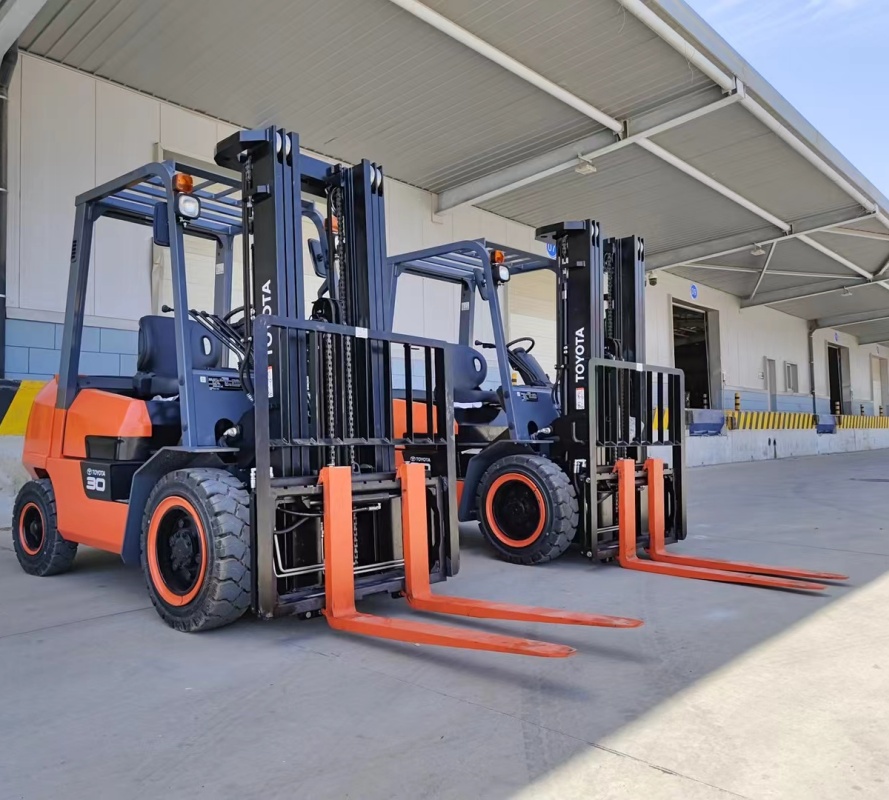
toyota 9 series forklift — heavy-duty industrial applications, high capacity, robust IC powertrains; best for outdoor yards, port operations, heavy manufacturing.
-
toyota 8 series forklift — flexible mid-to-high capacity machines, suitable for mixed indoor/outdoor use, often with advanced ergonomics and higher lifting specs.
-
toyota 7 series forklift — reliable mid-range models with strong performance for warehousing and production lines; good balance of cost and capability.
-
toyota 6 series forklift — commonly offers electric options geared toward warehouse efficiency and operator comfort; well-suited for busy indoor operations.
-
toyota 5 series forklift — compact and maneuverable, ideal for narrow aisles, light-to-medium loads, and operations prioritizing space utilization.
Note: model naming and availability vary by market and year — always consult a local toyota forklift dealer for exact specifications and current series offerings.
6. Ergonomics, operator safety & productivity
Operator comfort reduces turnover and improves throughput.
-
Controls layout, seat ergonomics, visibility aids (cameras, mirrors), and advanced safety systems (automatic parking brake, stability systems) should factor into selection. Many toyota material handling products include integrated safety technologies—test drive units under real workflows to evaluate ergonomic fit.
7. Serviceability, parts availability & dealer support
A forklift’s uptime depends on after-sales support.
-
Dealer network: Buying from an established toyota forklift dealer ensures access to genuine parts, certified technicians, and timely maintenance.
-
Warranty & service plans: Compare preventive maintenance packages and response times. A low upfront price can be costly if spare parts take weeks to arrive.
8. Total cost of ownership (TCO) checklist
When comparing options, compute realistic TCO:
-
Purchase price vs residual value
-
Fuel/electricity and consumables
-
Maintenance and parts cost per operating hour
-
Downtime risk and service response time from your toyota forklift dealer
-
Training and safety compliance costs
Quick decision checklist
-
What is your maximum weight and load center?
-
Indoor or outdoor primary use?
-
Required lift height and mast configuration.
-
Continuous hours per shift (single vs multi-shift).
-
Space constraints (aisle width, turning radius).
-
Are attachments required? Which ones?
-
Local emissions or noise restrictions?
-
Preferred power type and total lifecycle budget.
Conclusion & Call to action
Choosing the right Toyota forklift is a strategic decision that affects safety, productivity, and operating costs. Whether you need a compact toyota 5 series forklift for tight aisles or a robust toyota 9 series forklift for heavy outdoor duty, an experienced toyota forklift dealer can help match machine specifications to real-world workflows and provide lifecycle support. Contact our team today for a personalized assessment, on-site evaluation, and a no-obligation proposal tailored to your material handling needs.
Speak with a certified toyota forklift dealer for spec sheets, demo bookings, and TCO analysis.