

As core equipment in modern logistics and warehousing, a forklift's operating condition directly affects a company's production efficiency and safety level. Scientific and reasonable maintenance not only extends the forklift's service life and reduces failure rates but also significantly improves work efficiency and reduces economic losses from unexpected downtime.
Key Factors Affecting Forklift Maintenance
Relationship Between Usage Frequency and Maintenance Cycle
Usage frequency is the primary factor when creating a maintenance plan. Based on usage intensity, forklifts can be divided into the following categories:
• High-intensity use: Working more than 8 hours per day, typically used in three-shift production environments. These forklifts should strictly follow or even shorten standard maintenance cycles, with a recommended basic maintenance cycle of once every 1.5 months.
• Medium-intensity use: Working 4-8 hours per day, common in single or double-shift companies. These forklifts can follow the standard maintenance cycle of basic maintenance once every two months.
• Low-intensity use: Working less than 4 hours per day or non-continuous use. These forklifts can have slightly extended basic maintenance cycles, but not exceeding 3 months, and daily checks should be strengthened.
Professional research shows that forklift failure rates have a non-linear relationship with usage time. After a certain period of use, failure rates rise sharply. Therefore, even low-frequency use forklifts should not have overly extended maintenance cycles to prevent the cumulative effect of potential failures.

Impact of Working Environment on Maintenance Strategy
The working environment directly affects the forklift's wear level and failure types. Scientific maintenance strategies should fully consider environmental factors:
• Indoor environment: Such as standard warehouses and production workshops. These environments are relatively stable. Maintenance focus should be on regular checks of the transmission system, hydraulic system, and electrical system.
• Outdoor environment: Such as cargo yards and docks. Forklifts exposed to natural environments face more challenges. Maintenance should focus on rust prevention, electrical system waterproofing, and tire inspection.
• Special environments: Such as cold storage, chemical plants, and food processing plants. These environments have special requirements for forklifts, and maintenance plans should be adjusted accordingly:
• Cold storage environment: Focus on anti-freeze for hydraulic systems and moisture-proof for electrical systems
• Chemical environment: Strengthen anti-corrosion treatment and increase safety device inspection frequency
• Food environment: Ensure no leakage in the lubrication system to avoid food contamination
Environmental factors not only affect maintenance cycles but also determine the key maintenance items. For example, in dusty environments, the cleaning frequency of air filters and hydraulic systems should be greatly increased. In high-temperature environments, cooling and lubrication systems need more frequent checks.
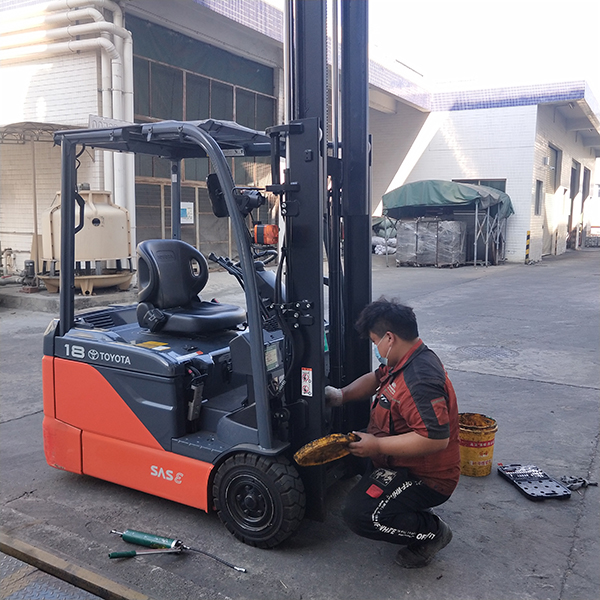
Operator Management and Maintenance Quality
Forklift operators are the first responsible persons for daily maintenance. Their management model directly affects maintenance results:
• Fixed operator model: The one-person-per-vehicle system helps develop operators' sense of equipment responsibility, making them more familiar with equipment conditions and able to detect abnormalities promptly. In this model, an individual maintenance responsibility system can be established with clear daily maintenance tasks.
• Multiple operator rotation model: In this model, equipment wear risk increases. A strict handover inspection system should be established to ensure good equipment condition at each handover. Meanwhile, professional maintenance personnel should increase inspection frequency.
• Operator training system: Regardless of the operation model, establishing a complete training system is crucial. Training content should include:
• Basic equipment structure and working principles
• Daily inspection and maintenance points
• Common fault identification methods
• Emergency handling procedures
Research data shows that professionally trained operators can reduce equipment failure rates by more than 30% and significantly extend equipment service life. Therefore, investing in operator training is an efficient way to improve forklift maintenance quality.

Toyota Global Standard Forklift Maintenance System
As a global leading forklift manufacturer, Toyota's maintenance standards are widely recognized and adopted. Toyota global standards divide forklift maintenance into two levels: basic maintenance and annual maintenance.
Basic Maintenance: Ensuring Daily Reliable Operation
According to Toyota global standards, forklifts should undergo basic maintenance every two months. The main contents of basic maintenance include:
1. Vehicle Lubrication System Maintenance
The lubrication system is the foundation for normal forklift operation. Good lubrication can significantly reduce mechanical wear:
• Lubrication point check and addition: Check all specified lubrication points, including door hinges, chains, bearings, etc., and add appropriate lubricating oil or grease
• Lubricating oil quality assessment: Check the color, viscosity, and impurity condition of lubricating oil, and replace it promptly if abnormalities are found
• Chain lubrication: Pay special attention to the lubrication state of lifting chains to ensure smooth operation without abnormal noise
Professional tip: Use specialized lubrication diagrams to guide lubrication work, ensuring no lubrication points are missed. For high-load areas, choose grease with good extreme pressure performance.
2. Electrical System Cleaning and Inspection
The electrical system is the nerve center of modern forklifts. Its reliability directly affects overall equipment performance:
• Circuit connection check: Check that all electrical connections are secure, without looseness or corrosion
• Circuit cleaning: Use specialized electrical cleaners to remove dust and oil from circuit connectors and wire harnesses
• Electrical component function test: Test the working condition of switches, relays, controllers, and other electrical components
• Line insulation check: Use a multimeter to check line insulation performance to prevent short circuit risks
Note: When cleaning the electrical system, disconnect the power supply, avoid using conductive cleaning agents, and ensure connectors are completely dry before reconnecting.
3. Professional Battery System Maintenance
For electric forklifts, battery system maintenance is particularly important:
• Battery electrolyte check: Check electrolyte level and specific gravity, add distilled water when necessary
• Battery terminal cleaning: Remove oxides from terminals and apply specialized anti-corrosion agents
• Charging system check: Confirm the charger is working normally with reasonable charging parameter settings
• Battery equalization charging: Perform regular equalization charging to extend battery life
Professional advice: Use a battery monitoring system to record battery performance data, establish battery health records, predict battery life, and optimize usage strategies.
4. Comprehensive Safety System Check
The safety system concerns the safety of operators and goods and cannot be overlooked:
• Braking system check: Test braking performance, check brake fluid level and pipeline condition
• Steering system check: Evaluate steering flexibility and precision, check the steering hydraulic system
• Warning device test: Ensure horn, warning lights, and reverse buzzer are working properly
• Safety interlock device verification: Test seat safety switch, emergency power-off switch, and other safety devices
Safety tip: Brake system checks should be performed in both unloaded and fully loaded conditions to ensure braking reliability in various working conditions.
5. Precise Adjustment of Moving Parts
The adjustment of moving parts directly affects the forklift's operation precision and efficiency:
• Chain tension adjustment: Adjust chain tension according to manufacturer specifications; both too loose and too tight will accelerate wear
• Fork arm parallelism adjustment: Ensure fork arms are parallel and horizontal to improve loading and unloading precision
• Operating lever travel adjustment: Optimize the travel and resistance of various operating levers to enhance operation comfort
• Hydraulic system pressure adjustment: Adjust hydraulic system working pressure according to load requirements
Technical point: Use professional tools and measuring instruments for adjustments, follow the technical parameters provided by the manufacturer for precise adjustment, and avoid operating based on experience.
Forklift professional maintenance is a systematic project requiring scientific planning from multiple dimensions such as usage frequency, working environment, and operator management. Following Toyota's global standard maintenance system and developing personalized maintenance strategies based on company actual situations can significantly improve forklift reliability and service life, reduce operating costs, and enhance work efficiency.