

In today's highly competitive logistics and supply chain landscape, industrial warehouse managers, third-party logistics (3PL) providers, and bonded warehouse operators face a critical three-fold dilemma: skyrocketing commercial land rents, severe floor space limitations, and an inability to expand horizontally. Standard heavy-duty reach trucks require wide operational channels, meaning a substantial percentage of expensive square footage is entirely wasted on aisle clearings rather than revenue-generating pallet placement. When standard storage configurations reach their limit, businesses must look to revolutionary warehouse automation and material handling equipment. The definitive answer to this industry-wide challenge is the implementation of a Toyota VNA forklift, specifically engineered to eliminate spatial inefficiencies and double your volumetric storage density without requiring physical facility relocation
What is a Toyota Very Narrow Aisle Forklift?
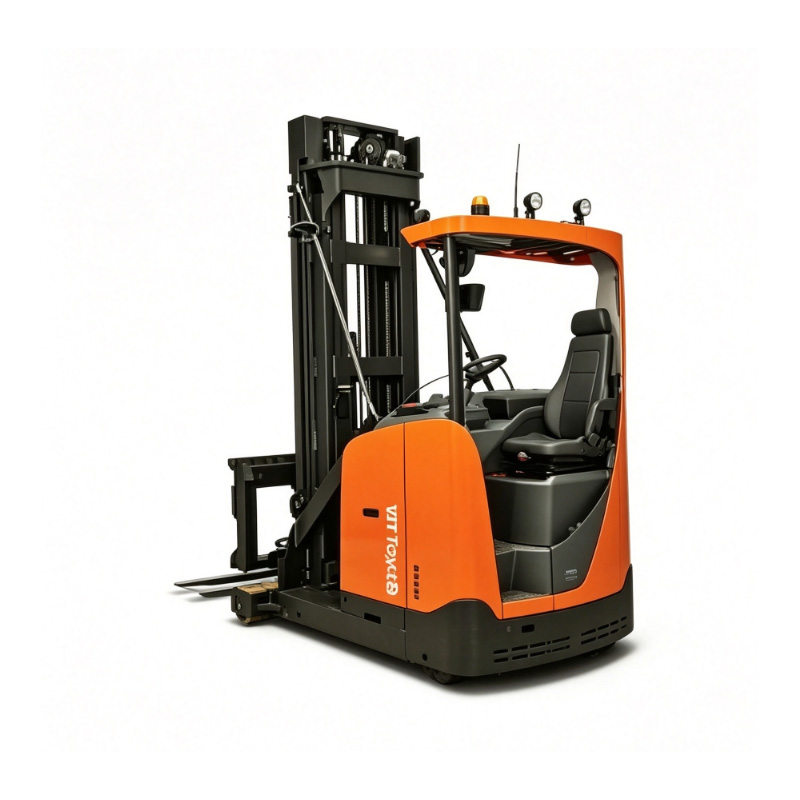
A Toyota Very Narrow Aisle forklift represents the pinnacle of specialized industrial engineering, uniquely configured to streamline pallet handling within ultra-dense configurations. Unlike traditional sit-down counterbalanced units or standard reach trucks that require a wide radius to physically turn the entire vehicle chassis toward a racking bay, a Toyota VNA forklift utilizes an advanced, integrated 3-way turret head mechanism. The chassis remains perfectly parallel to the aisle throughout the entire cycle. The fork carriage itself rotates 180 degrees seamlessly, allowing the attachment to slide laterally to the left, right, or straight ahead to retrieve or deposit loaded pallets. Built on the heritage of robust Toyota Forklift engineering, these high-efficiency units are designed to interface seamlessly with wire-guided or mechanical rail-guided floor systems, turning tight rack structures into highly predictable, ultra-fast, semi-automated logistics channels.
Toyota VRE vs. Toyota VCE: Man-Down vs. Man-Up Solutions
Toyota Material Handling offers two distinct variations of its high-capacity VNA family to suit specific operational goals: the Toyota VRE Series (Man-Down configuration) and the Toyota VCE Series (Man-Up configuration). Selecting the correct asset depends entirely on whether your workflow prioritizes high-throughput pallet moves or mixed-case manual order fulfillment.
The Toyota VRE Man-Down series positions the operator cabin directly on the heavy-duty lower chassis. This layout is optimized for pure, high-speed, high-frequency pallet replenishment and deep-storage indexing, as the driver remains grounded while the robust mast system lifts loads to the high tiers. Conversely, the Toyota VCE Man-Up series features an advanced elevating cabin that lifts the operator alongside the fork carriage and the load simultaneously. This design provides the operator with perfect, eye-level visibility for precision high-altitude pallet placement and allows them to execute manual item picking straight from the upper rack levels, offering an incredibly versatile two-in-one solution for dynamic modern fulfillment facilities.
Key Benefits of Implementing a Toyota VNA Forklift in Your Warehouse
Integrating a specialized Toyota Very Narrow Aisle forklift into your supply chain infrastructure delivers multiple measurable operational advantages:
● Unparalleled Space Optimization: Standard reach truck setups require a clear aisle width of approximately 3.2 meters to 3.5 meters to safely execute maneuvers. A Toyota VNA forklift slashes this requirement to a minimum operating clearance of just 1.6 meters. By compressing the structural horizontal distance between racks, you can place multiple additional rows of heavy shelves into the exact same facility square footage, immediately doubling your total storage capacity and doubling your warehouse cube utilization.
● Maximum Vertical Exploitation: These trucks are equipped with ultra-rigid, clear-view mast structures that extend up to extreme heights with minimal capacity derating. This allows facilities to exploit high-level vertical airspace that previously went unused, turning empty building clearance into productive storage real estate.
● Advanced Intelligent Safety: Moving heavy payloads within a narrow 1.6-meter channel demands absolute precision. Toyota integrates an intelligent drive control system that connects to ground wire tracking. The truck automatically governs its travel speed relative to lift height, while electronic alignment assists perfectly center the forks against the pallet slot. This eliminates costly racking scrapes, structural collisions, and product damage.
Complete Technical Specification Comparison
To assist capital expenditure decision-makers in determining the perfect asset variant for their automated racking design, the table below provides a full side-by-side technical breakdown of the two premier choices within the VNA category.
| Technical Specification Parameters | Toyota VRE Series (Man-Down) | Toyota VCE Series (Man-Up) |
|---|---|---|
| Primary Operational Application | High-speed pallet replenishment and stacking | High-altitude stacking and manual picking |
| Min. Operating Aisle Width | 1.6 meters | 1.65 meters |
| Max. Mast Lift Height | 11.0 meters | 14.8 meters |
| Max. Load Lift Capacity | 1350 kilograms | 1500 kilograms |
| Cabin Position during Lift | Fixed on chassis (Ground level) | Elevates with the mast assembly |
| Guidance Compatibility | Inductive Wire / Mechanical Rail | Inductive Wire / Mechanical Rail |
The Complete ROI & Integration Solution for Smart Warehousing
Upgrading your logistics hub from standard machinery to a premium Toyota Forklift layout requires a programmatic approach to integration to maximize your Return on Investment (ROI):
1. Floor Flatness Verification: Operating a mast at 14 meters within a tight 1.6-meter aisle requires absolute structural stability. Floor flatness must comply strictly with DIN 18202 VDMA standards to prevent mast sway.
2. Guidance System Installation: Choose between embedding inductive guidance wires under the concrete or bolting mechanical steel profile guide rails down along the aisle entry paths to lock the truck onto a perfectly straight path.
3. Racking Interfacing and Fine-Tuning: Re-configure beam heights and implement high-durability end-of-aisle safety buffers to match the specific physical parameters of the 3-way turret head assembly.
4. Fleet Management Integration: Connect the truck's internal telemetry systems into your Warehouse Management System (WMS) to automate path selection, location targeting, and real-time weight verification.
Conclusion
Deploying a Toyota very narrow aisle forklift is a high-impact strategic business decision that transforms space limitations into measurable competitive advantages. By compressing operational aisles down to 1.6 meters and utilizing vertical airspace with elite engineering stability, the Toyota VRE and VCE VNA series provide companies a proven blueprint to eliminate real estate bottlenecks, lower total operational costs, and future-proof their high-density supply chains.
FAQs
Q1: What is the absolute minimum aisle width required for a Toyota VNA Forklift?
A1: The absolute minimum operating aisle clearance required for standard pallets using the Toyota VRE or VCE series is 1.6 meters, depending on your precise load dimensions and layout.
Q2: Can a Toyota VNA Forklift move freely outside the narrow aisles?
A2: Yes. While they deliver maximum efficiency within guided narrow aisles, these trucks can transition outside the rows to move across staging areas or transfer zones.
Contact Us