

When looking for a reliable material handling solution, buying a used Toyota forklift is one of the smartest investments a business can make. Toyota has built a stellar reputation for durability and high resale value. However, the market for used Toyota forklifts can be tricky. Without professional expertise and a rigorous inspection process, you risk purchasing a refurbished accident vehicle or a unit with a clocked hour meter.
As an industry veteran who has inspected hundreds of used forklift Toyota models, I have seen firsthand how a shiny new coat of paint can hide catastrophic hydraulic or engine failures. In this comprehensive guide, we will leverage real-world mechanical experience to provide you with a foolproof, step-by-step solution to evaluate a used Toyota forklift and ensure you get the exact performance you pay for.
Chapter 1: Basic Information Verification
1.1 Verifying the Serial Number and Chassis Nameplates
Before turning the key, you must eliminate the risk of purchasing a salvaged or assembled Toyota used forklift. A genuine Toyota forklift features three matching nameplates: on the chassis, the counterweight, and inside the cabin. Cross-check the manufacturing year, tonnage, and model across all three locations. If any nameplate is missing, blurry, or shows signs of tampering, walk away immediately. Additionally, locate the stamped serial number on the frame. It should be crisp without any grinding marks. You can contact an authorized Toyota dealer to verify the original factory archives and service history.
1.2 Cross-Validating the Hour Meter with Real-World Wear
Never trust the hour meter blindly when inspecting used Toyota forklifts. Odometers are notoriously easy to tamper with. To uncover the true operational age of a Toyota used forklifts, perform a multi-dimensional wear cross-check:
● Pedals and Control Levers: Heavy wear or brand-new replacement rubbers on a supposedly "low-hour" machine is a major red flag.
● Seat Condition: Check if the original seat fabric is cracked, torn, or sagging.
● Fork Root and Chain Rollers: Measure the wear depth at the heel of the forks and the play in the mast chain rollers.
● Expert Tip: Modern electronic control systems store deep running data. Connecting a diagnostic tool to read the internal ECU runtime and comparing it with the dashboard hour meter will instantly expose a clocked unit.
1.3 Identifying Past Operating Environments
The environment where previously used Toyota forklift trucks worked dictates their remaining lifespan.
● Cold Storage Units: Look for extensive corrosion in wiring harnesses and battery compartments, alongside hardened rubber seals. These units are prone to frequent electrical failures.
● Chemical Plants: Check the chassis and hydraulic cylinders for chemical pitting or severe corrosion.
● Construction Sites: Inspect for bent forks, deformed masts, and heavy welding repairs on the frame resulting from severe overloading.
| HOUR METER CROSS-CHECK MATRIX | ||
| Component Verified | Expected Wear (Low Hours) | Red Flags (Clocked Meter) |
|
Pedals & Knobs
Seat Cushion
Fork Heel Thickness
ECU vs Dashboard Log
|
Crisp textures, minor rub Firm, original upholstery > 90% of original spec Perfect match (<5% variance)
|
Smooth/bald, or brand new Deep sag, torn, unoriginal Significant wear, thinning Discrepancy > 500 hours |
Chapter 2: Diesel Used Toyota Forklift Inspection
2.1 Engine Core Diagnostics
The internal combustion engine is the heart of a diesel used Toyota forklift.
Cold Start Test: The engine must be tested after sitting cold overnight. It should crank and fire up on the first try without hesitation or violent shaking.
Exhaust Smoke Analysis: * Blue Smoke: Indicates oil burning. The piston rings or valve guides are worn out, leading to expensive overhaul costs.
● Black Smoke: Indicates incomplete combustion, often caused by clogged air filters or aging fuel injectors.
● White Smoke: Indicates coolant leaking into the combustion chamber (blown head gasket), which is a critical failure.
Oil Quality Check: Pull the dipstick. If the oil looks milky or emulsified, water has mixed into the oil. Excessive metal debris in the oil indicates severe internal engine wear.
Idle and Acceleration: The engine should idle smoothly without rhythmic knocking. When simulating a ramp climb, power delivery must feel robust without bogging down.
2.2 Cooling and Hydraulic Systems
Check the radiator core for blockages, damage, or white coolant staining. Run the forklift under simulated lifting for 10 minutes; the coolant temperature must remain stable.
To check hydraulic cylinder integrity, lift a load to maximum height and let it sit for 10 minutes. Drastic drifting or sinking indicates leaking piston seals or a faulty control valve.
Ensure mast lifting, tilting, and side-shifting function smoothly without jerking or shuddering. Inspect all lines for fluid wetness.
2.3 Structural Integrity
Examine the underside of the chassis for deep structural rust, heavy impacts, or fresh welds. The counterweight must be free of cracks, and the overhead guard must never show signs of structural straightening from a rollover accident.
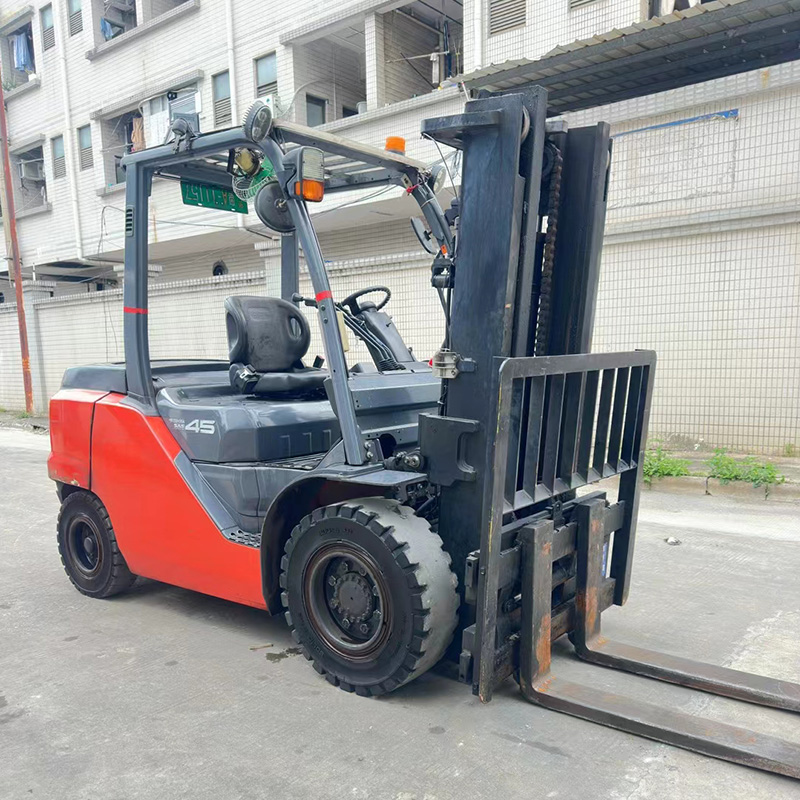
Chapter 3: Electric Used Toyota Forklift Inspection
3.1 Battery Health Index (The High-Cost Component)
When sourcing a used forklift toyota powered by electricity, the battery represents up to 40% of the vehicle’s residual value.
● Lead-Acid Batteries: If the battery is over 5 years old, it is nearing the end of its life cycle. Check for physical cell bloating, acid leaks, or heavily oxidized terminals. Fully charge the unit and monitor voltage drop under a load test; immediate drainage indicates diminished capacity.
● Lithium Batteries: Connect to the Battery Management System (BMS) to retrieve exact telemetry data. Review total charge cycles and the State of Health (SOH) percentage. An SOH below 70% means a highly expensive battery replacement package will be required shortly.
3.2 Motors, Controllers, and Electrical Wiring
Drive the electric Toyota forklift used through its speed range. The drive motor should whine smoothly without high-pitched squealing or shuddering. Inspect the main controller bay: wiring harnesses must be neatly routed, free from exposed copper, uninsulated splicing, or heat-induced blackening. Verify that Toyota's proprietary SAS (System of Active Stability) and OPSS (Operator Presence Sensing System) are fully operational; if a dealer has bypassed these safety networks to mask faults, reject the truck immediately.
Chapter 4: Universal Structural Inspection
4.1 Mast, Forks, and Chains
This physical structural evaluation applies to all used Toyota forklifts. The mast channels must be straight, free of twisting, and possess uniform clearance on both sides. Inspect the forks closely for hairline cracks, structural welding, or bending. Measure the thickness of the fork arm; if wear exceeds 10% of the original factory specifications, they are legally non-compliant and must be replaced. The lift chains must be free of frozen links or excessive rust, and chain elongation must be within safe margins.
4.2 Braking, Steering, and Tires
The parking brake must securely hold the forklift on a 15% incline under load. Foot brakes should engage evenly without pulling the vehicle to one side. The steering wheel should have minimal free play, and the rear steer axle steering knuckles should operate smoothly without mechanical binding. For pneumatic tires, check for deep sidewall cracks or tread flattening; for solid rubber tires, watch for chunking or uneven flat spots.
Chapter 5: Full Load Road Test & Refurbishment Detection
5.1 The Mandatory Full Load Road Test
Never finalize a purchase based on an unloaded inspection. Load the machine to its rated capacity. Drive it at both low and high speeds, perform frequent lifting cycles, stack a pallet at high elevation, and make tight turns. A full load test instantly exposes hidden flaws that remain hidden during empty runs, such as hydraulic pressure drops, slipping transmissions, structural chassis flexing, or fading brakes on used Toyota forklift trucks.
5.2 Detecting Refurbished Accident Vehicles
● Fresh Paint Traps: Inspect the bolts, chassis undercarriage, and tight crevices within the mast assembly. Factory paint lines are clean; aftermarket resprays almost always leave overspray on wiring, rubber hoses, and grease fittings.
● Chassis Realignment Repair: Search for grind marks, non-factory weld beads, or thick structural plates welded onto the chassis or counterweight interior. These reveal a past major structural collision.
● Aftermarket Sub-components: Verify that cylinders, hydraulic pumps, and electronic controllers carry original Toyota stamping. Shabby, cheap aftermarket replacements lead to high breakdown rates later.
Chapter 6: Conclusion & Machine Grading
Summary Matrix for Toyota Forklift Condition Grading
To simplify your procurement process, we have categorized the condition of available secondary market stock into three operational tiers:
| TOYOTA FORKLIFT CONDITION TIERS | ||
| Grade | Operational Hours | Mechanical Status |
| Premier Tier | 10,000 - 20,000 Hours | Original maintenance logs, no overhauls, flawless battery/engine performance. |
| Standard Tier | 30,000 - 40,000 Hours | Regular servicing, normal wearing parts replaced, major core components untouched. |
| Substandard | Above 50,000 Hours | High risk of clocked meters, overhauled engine/motor, retired cold-storage units. |
By systematically cross-referencing factory serial numbers, checking physical engine emissions, reading internal electrical SOH metrics, and demanding a full load test, you can confidently secure a reliable, high-performing asset for your warehouse operations.
Contact Us