
Why Toyota Diesel Forklifts Still Dominate Outdoor Heavy-Duty Material Handling
In today's industrial environment, efficiency alone is no longer enough. Warehouses, ports, construction sites, and outdoor logistics centers require equipment that can survive constant heavy loads, long operating hours, rough terrain, and extreme weather conditions. This is exactly why the Toyota diesel forklift continues to hold a dominant position in the global heavy-duty forklift market.
Unlike many forklifts designed mainly for light indoor operations, Toyota diesel forklifts are engineered for endurance. Their reputation is not built purely on horsepower, but on the ability to deliver stable performance hour after hour without overheating, power fading, or excessive mechanical wear. For industries where downtime directly translates into financial loss, this reliability becomes a critical advantage.
One reason the diesel forklift Toyota stands out is its industrial-grade engineering philosophy. Toyota focuses heavily on balancing engine output, cooling efficiency, chassis durability, and operator control. Instead of maximizing short-term peak performance, the design emphasizes long-term operational stability. This approach makes the forklift highly suitable for businesses running double-shift or even 24-hour operations.
Outdoor environments are especially demanding on forklift systems. Dust, mud, uneven roads, steep slopes, and heavy cargo continuously stress the drivetrain and hydraulic components. Many ordinary forklifts gradually lose lifting power under these conditions, especially during long summer operations. However, the Toyota forklift diesel maintains strong torque delivery and stable hydraulic response even after prolonged use.
Another major reason companies choose Toyota diesel forklift truck models is their structural durability. The reinforced chassis and thickened steel frame are specifically designed to absorb impact and vibration from rough terrain. Whether transporting heavy building materials or operating inside industrial yards, the machine remains stable and resistant to deformation over years of use.
In many industries, forklifts are expected to work almost nonstop. The challenge is not simply moving cargo — it is maintaining consistent productivity without unexpected breakdowns. This is where the real value of a diesel Toyota forklift becomes obvious. Stable cooling systems, efficient fuel combustion, and heavy-duty transmission systems allow operators to continue working without worrying about sudden overheating or power loss.
For businesses seeking long-term return on investment, the decision often comes down to durability and operating cost rather than initial purchase price alone. This explains why demand for Toyota diesel forklifts for sale remains consistently strong across construction, logistics, manufacturing, and outdoor material handling industries worldwide.
Not Just Power: The Real Core Advantage Is Thermal Stability
Many forklift buyers focus only on engine power when comparing heavy-duty models. However, in real industrial environments, peak horsepower matters far less than thermal stability. A forklift that performs well for one hour but overheats after continuous operation cannot truly support high-intensity logistics work. This is where the Toyota diesel forklift demonstrates its real engineering advantage.
In many outdoor operations, forklifts work continuously for long periods under extreme load conditions. Frequent lifting, constant acceleration, uphill transportation, and heavy hydraulic usage generate enormous heat inside the engine compartment and hydraulic system. Poor heat dissipation causes many forklifts to gradually lose responsiveness, reduce lifting efficiency, and even shut down unexpectedly.
The biggest strength of Toyota diesel forklifts is their ability to maintain stable operating temperatures during prolonged heavy-duty usage. Toyota engineers optimize airflow channels, radiator efficiency, hydraulic oil cooling circulation, and engine thermal management as one integrated system rather than treating cooling as an afterthought.
This integrated thermal design allows the diesel forklift toyota to maintain smooth hydraulic response even after many hours of nonstop work. Operators often notice that some forklifts feel increasingly “sluggish” during long shifts, especially in summer conditions. In contrast, Toyota's diesel models maintain consistent acceleration, lifting force, and steering responsiveness throughout the day.
Another overlooked factor is hydraulic heat buildup. Continuous lifting operations generate high hydraulic pressure, which can quickly raise oil temperature. Once hydraulic oil overheats, lifting precision and overall system efficiency decline rapidly. The Toyota forklift diesel uses optimized hydraulic cooling circuits that reduce heat accumulation and help preserve long-term system stability.
For businesses operating in ports, building material yards, mining areas, and industrial construction sites, overheating is more than a technical inconvenience — it directly affects productivity and operating cost. Unexpected downtime can delay shipments, reduce loading efficiency, and increase labor costs. This explains why many companies prioritize thermal reliability when choosing a Toyota diesel forklift truck.
Toyota's cooling performance becomes even more important in high-temperature regions. During summer operations, some forklifts experience severe engine strain after hours of continuous use. However, the diesel toyota forklift is specifically engineered to maintain stable output under high ambient temperatures without noticeable power decline.
Ultimately, real industrial productivity depends not only on how strong a forklift feels at startup, but on whether it can sustain that strength throughout the entire work cycle. This long-duration operational stability is one of the main reasons global demand for Toyota diesel forklifts for sale remains consistently strong.
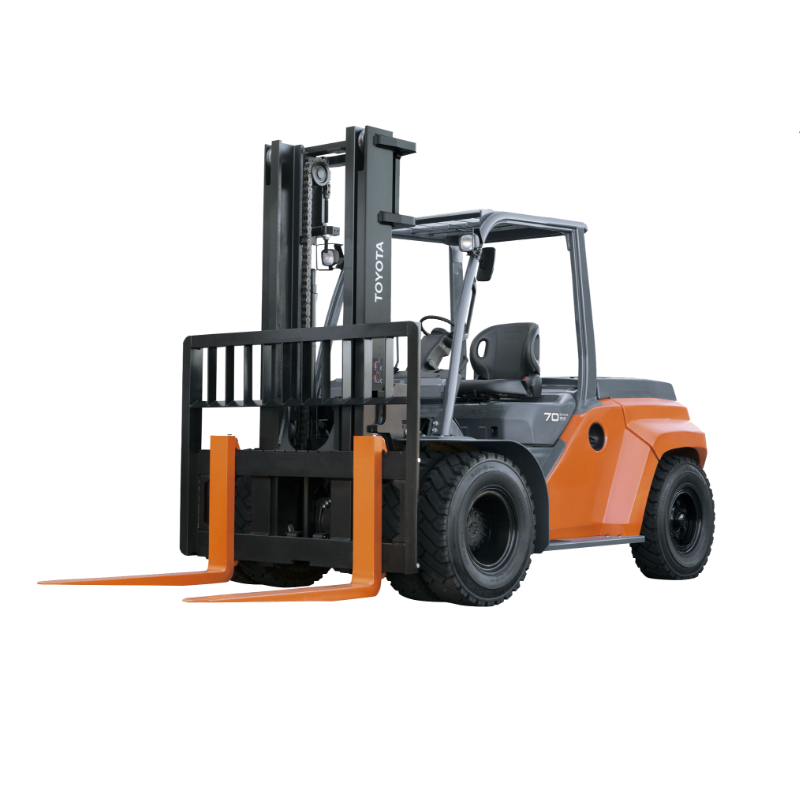
Heavy Torque Performance for Extreme Loads and Rough Terrain
A forklift's real capability is not measured on a smooth warehouse floor. Its true performance is revealed when carrying heavy cargo across uneven terrain, muddy construction roads, steep ramps, and outdoor industrial environments. This is exactly where the Toyota diesel forklift proves its superior torque performance.
Unlike electric forklifts that may struggle under prolonged heavy loads, Toyota diesel forklifts deliver continuous low-end torque output. This characteristic is critical for outdoor applications because industrial operations rarely involve perfect road conditions. Heavy cargo transportation often requires climbing slopes, crossing gravel roads, and operating on unstable surfaces.
The engine tuning of the diesel forklift Toyota focuses heavily on torque reserve rather than just top speed. Even under full-load conditions, the forklift maintains powerful acceleration and stable traction. Operators can feel the difference immediately when transporting steel materials, concrete blocks, timber, or industrial machinery.
Torque stability becomes especially important during uphill operations. Some forklifts experience significant power loss while climbing with full loads, forcing operators to slow down or stop midway. However, the Toyota forklift diesel maintains strong pulling force even on demanding slopes, improving transportation efficiency and operational safety.
Another major advantage is drivetrain durability. Rough outdoor terrain continuously impacts transmission systems, axles, and suspension components. Toyota designs its diesel forklifts with reinforced driveline systems capable of absorbing repeated shock loads without premature wear.
In industries such as ports and stone yards, forklifts often work on dusty or uneven surfaces for long hours. Under these conditions, engine responsiveness and traction control become essential. The Toyota diesel forklift truck provides smooth power delivery without sudden jerking, helping operators maintain precise control even when handling oversized cargo.
Heavy torque also improves operational confidence. A forklift that hesitates under load can create dangerous situations during lifting and transportation. By contrast, the diesel Toyota forklift provides stable movement and predictable response, allowing operators to maneuver safely even in narrow outdoor workspaces.
This balance between power, traction, and durability is one reason why many industrial buyers actively search for Toyota diesel forklifts for sale when expanding outdoor logistics fleets. Businesses need forklifts that can handle real-world industrial abuse rather than ideal showroom conditions.
Reinforced Chassis Design That Outlasts Ordinary Forklifts
In heavy industrial environments, forklift durability depends far more on structural integrity than appearance. A machine may look powerful externally, but if the frame and chassis cannot withstand years of vibration, heavy impacts, and overloaded operation, long-term reliability quickly disappears. This is one of the reasons why the Toyota diesel forklift has earned a reputation for exceptional durability worldwide.
Toyota approaches forklift durability from an industrial engineering perspective. Instead of focusing only on visible exterior components, the company strengthens the underlying chassis architecture that supports the entire machine. The result is a forklift capable of enduring years of high-frequency operation without significant structural fatigue.
The reinforced frame structure used in Toyota diesel forklifts is specifically designed for outdoor heavy-duty work. Thickened steel sections improve torsional rigidity and reduce frame flex during full-load transportation. This becomes especially important when forklifts operate on rough roads, uneven surfaces, or loading ramps.
Long-term structural stability directly affects operational precision. Many forklifts gradually develop body deformation after years of hard usage, causing steering instability, mast misalignment, or uneven tire wear. However, the diesel forklift Toyota maintains stronger overall body stability, even under demanding industrial conditions.
Another key advantage lies in vibration resistance. Construction sites, ports, and industrial yards expose forklifts to constant mechanical shock. Repeated vibration can damage weak welds, loosen structural connections, and accelerate wear throughout the vehicle. Toyota’s reinforced chassis design helps distribute impact stress more evenly across the frame.
The Toyota forklift diesel also benefits from highly durable mast and axle systems. Heavy cargo handling places enormous pressure on these components every day. Toyota engineers focus heavily on load distribution and structural reinforcement to ensure long service life even under continuous heavy lifting operations.
Durability is not only about surviving harsh conditions today, but it also determines long-term maintenance cost. Forklifts with weak structural designs often require expensive repairs after several years of heavy use. By contrast, the Toyota diesel forklift truck is widely recognized for maintaining stable performance over extended operational lifecycles.
For many businesses, this durability translates directly into financial value. Equipment replacement costs, maintenance downtime, and repair frequency all impact profitability. This is why companies investing in Toyota diesel forklifts for sale often prioritize structural reliability over short-term pricing advantages.
For more details, please read the next article.
Contact Us