

Warehouse forklifts, as the name suggests, are industrial vehicles specifically designed for material handling and stacking operations within warehouses. With the increasing level of logistics automation, electric forklifts have become widely adopted in the warehousing industry due to their inherent advantages, including compact body structure, excellent maneuverability, lightweight design, and superior environmental performance. Below, we will detail the main types of warehouse forklifts:
Electric Pallet Truck
Electric pallet trucks are primarily used for horizontal transportation and loading/unloading operations within warehouses. Depending on the operating mode, they can be categorized into walkie, stand-on, and sit-on types, allowing enterprises to choose based on efficiency and operator comfort requirements. Furthermore, electric pallet stackers, as an extension, are further divided into full-electric pallet stackers and semi-electric pallet stackers. Full-electric stackers feature both electric drive and electric lift functions, offering effortless and efficient operation; while semi-electric stackers require manual pulling or pushing for movement, but their lifting function is electrically controlled.
Stacker Forklift
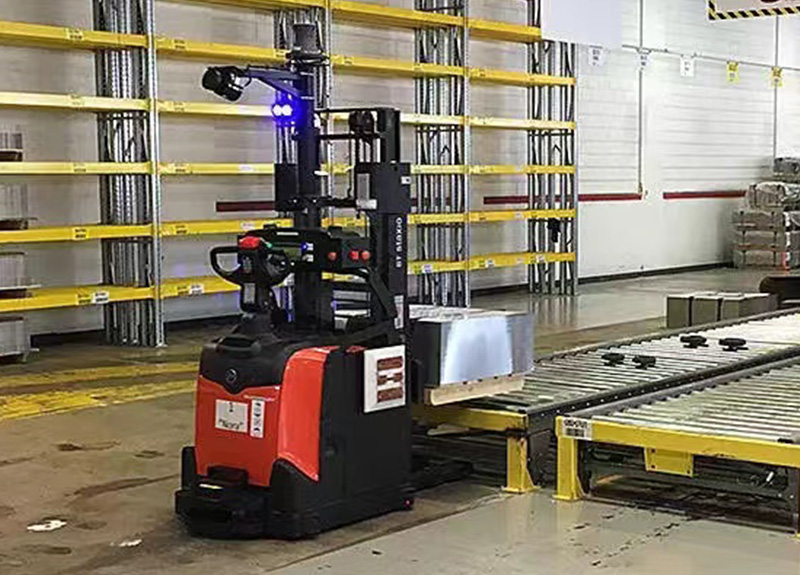
A stacker forklift, also known as a pallet stacker, is a wheeled handling vehicle used for loading, unloading, lifting, stacking, and short-distance transportation of palletized goods. Stacker forklifts have a mast but, unlike other lifting forklifts, do not have a driver's cabin, primarily to allow for flexible handling and stacking operations.
Counterbalance Forklift
The counterbalance forklift is one of the most widely used types of forklifts today. Its core design involves the forks extending beyond the front wheel centerline, with a counterbalance weight installed at the rear of the forklift to offset the overturning moment generated by the load, ensuring operational stability. Counterbalance forklifts equipped with pneumatic tires offer faster travel speeds and excellent climbing capabilities, broadening their scope of application. These forklifts are suitable for loading, unloading, stacking, and transporting goods in ports, railway stations, large freight yards, and within enterprise facilities. Notably, counterbalance forklifts with a capacity of less than 3 tons can also operate inside ship holds, train carriages, and containers. Their standard lifting height typically ranges from 2 to 4 meters.